
Quality Control Standards for Sourcing Tier-1 PV Suppliers in China
2026 Procurement Guide: Quality Control Standards for Sourcing Tier-1 PV Suppliers in China
Master China PV factory audits with our technical procurement guide. Evaluate IEC standards, EL testing, cell sorting, and ISO quality controls.
Mitigating Risk in High-Capacity PV Sourcing
Utility-scale and commercial PV projects face financial exposure when procurement decisions focus exclusively on upfront nameplate costs per watt. Latent manufacturing defects-such as micro-cracks, cell mismatch, EVA delamination, and PID (Potential-Induced Degradation)-frequently remain undetected during basic factory inspections. These issues manifest within 2 to 5 years of field deployment, driving performance degradation rates beyond the standard 0.55% annual threshold and increasing Levelized Cost of Electricity (LCOE).
For EPC contractors and project developers, verifying a manufacturing facility requires technical auditing beyond financial balance sheets. This guide outlines the specific quality assurance criteria required to evaluate a China PV factory. We examine cell-to-module processing parameters, 100% inline electroluminescence (EL) verification, ISO management frameworks, and production line automation standards necessary to protect capital investments over a 25-to-30-year operational lifecycle.
Quality Protocols Across the PV Manufacturing Value Chain
Achieving long-term power yields requires absolute material traceability and strict operational control at every stage of production. A tier-1 solar supplier operates fully automated manufacturing lines where human intervention is minimized, reducing mechanical stress on wafers and cells.
1. Wafer Slicing and Cell Grade Sorting
Quality control begins at the ingot and wafer level. High-grade N-type TOPCon or HJT wafers require controlled oxygen content (< 14 ppma) and tight resistivity variations (< 10%).
Inline Micro-Crack Detection: Automated optical inspection (AOI) screens 100% of incoming wafers for micro-fissures and edge chips before texturing.
Efficiency Binning: Cells are sorted into narrow efficiency intervals (0.1% steps) using multi-busbar (MBB) sorting machines. Sorting prevents mismatch losses inside the string, which otherwise cause localized hotspots and accelerated thermal degradation.
2. High-Precision Stringing and Electroluminescence (EL) Phase 1
During the lay-up process, infrared soldering or smart wire alignment attaches ribbons to cell busbars.
Soldering Temperature Calibration: Soldering irons or induction heaters are kept within ±5℃ of the target temperature (230℃ - 250℃) to prevent micro-fractures caused by thermal shock.
Pre-Lamination EL Inspection: Before encapsulating the matrix in EVA/POE films and solar glass, an inline high-resolution camera captures the first EL image. This step identifies cracked cells, broken busbars, or foreign debris before lamination locks the layer in place.
3. Vacuum Lamination and Polymer Cross-Linking
Lamination bonds the glass, encapsulant, cell matrix, backsheet (or double-glass structure), and frame into an airtight unit.
Gel Content Testing: Laboratory personnel verify that cross-linking ratios exceed 85% for EVA or 90% for POE via gel-content chemical extraction tests. Undercured encapsulants lead to moisture ingress, backsheet yellowing, and eventual delamination.
Temperature Uniformity: Vacuum laminators must maintain spatial temperature variance across the heating plate below ±1.5℃.

Industry Standards & ROI Impact
Defects directly degrade financial returns. A 1% increase in module failure rates over a 50MW project capacity increases operational expenditure (OpEx) while missing projected power purchase agreement (PPA) yield targets.
Evaluating suppliers against rigid technical benchmarks prevents capital expenditure (CapEx) write-downs.
|
Quality Inspection Parameter |
Standard Manufacturer Baseline |
Tier-1 Factory Benchmark (Hemao Standard) |
Project Risk Mitigated |
|
Electroluminescence (EL) Inspection |
Single-stage pass (Post-lamination only) |
Dual-stage 100% testing (Pre & Post-lamination, 24MP resolution) |
Micro-cracks, cell mismatch, inactive cell area |
|
Flash Testing Accuracy |
Class BBB simulator (±3% power tolerance) |
Class AAA+ simulator (±1% tolerance, temperature-corrected) |
Nameplate power mismatch, low yield returns |
|
Gel Content Verification |
Batch sampling (1 per week) |
Line-level testing (1 per shift/line, cross-link ratio > 88%) |
Encapsulant delamination, moisture ingress |
|
Mechanical Load Capability |
Static: 2400 Pa / 5400 Pa |
Dynamic Load Test: 2400 Pa at 10Hz (1,000 cycles) |
Cell cracking under heavy wind and snow load |
|
PID Resistance |
IEC 62804 standard (85°C / 85% RH, 96 hours) |
Extended testing: 85°C / 85% RH, 192 hours (<2% loss) |
High-voltage array degradation in humid environments |
LCOE and Financial Return Dynamics
Micro-cracks from poor factory handling act as variable resistors in the module circuit. Over time, reverse-bias heating creates localized hotspots exceeding 150℃. This breaks down the EVA encapsulant and damages adjacent cells.
Degradation Rate Impact: A standard module degrades at approximately 0.55% annually. High-grade modules produced under double-EL and low-stress stringing routines maintain annual degradation below 0.40%.
25-Year Cumulative Output: Over a 25-year operational lifecycle, a 0.15% reduction in annual degradation increases cumulative power output by approximately 3.6%, directly improving internal rate of return (IRR) metrics for asset owners.
System Integration & Quality Management Systems
Sourcing panels for large-scale deployments requires verification of integrated management frameworks. A China PV factory must show systematic compliance across all operational tiers.
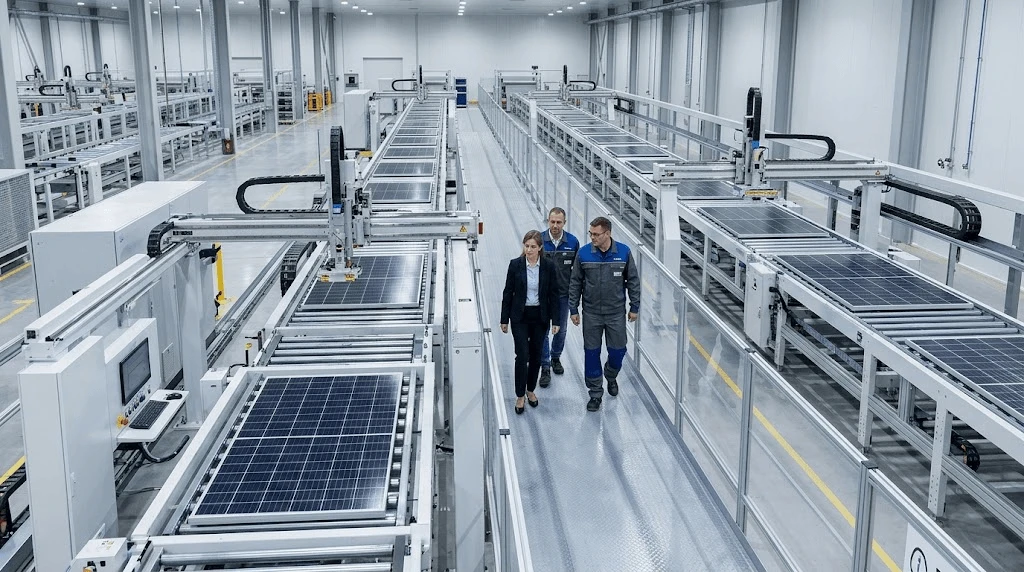
Factory Audit Verification Protocols
When reviewing supplier documentation or conducting on-site factory audits, verify four critical systems:
1.ISO 9001, 14001, and 45001 Integration: Audits must verify active implementation logs, calibration certificates for measuring instruments, and correct material storage conditions (e.g., climate-controlled rooms for uncured EVA/POE rolls at <25℃ and <60℃ relative humidity).
2. Full Material Traceability (MES Systems): The facility's Manufacturing Execution System (MES) must bind each module barcode to specific cell batches, raw ribbon lots, encapsulant rolls, and lamination temperature logs. If a panel fails in the field, the barcode must reveal its precise production context within seconds.
3. Balance of System (BOS) Compatibility: High-power modules (>600W) must maintain mechanical and electrical compatibility with tracking systems and central or string inverters. Junction boxes fitted with IP68-rated split bypass diodes ensure lower thermal resistance and prevent internal frame melting during partial shading conditions.
To review complete factory operational metrics and corporate compliance documentation, refer to our Company Profile.
Quality Control & Global Compliance
Exporting PV equipment across North America, Europe, Australia, and South America requires strict compliance with international testing standards.
Essential International Certifications
IEC 61215 / IEC 61730: Validates design qualification, type approval, and safety requirements for long-term outdoor operation.
UL 61730: Mandatory certification for North American grid connections, focusing on electrical fire safety and structural integrity.
Salt Mist Corrosion (IEC 61701 - Severity 6): Required for coastal or offshore installations where high ambient salinity degrades exposed aluminum frames and junction box seals.
Ammonia Corrosion (IEC 62716): Essential for agricultural PV installations subject to high atmospheric chemical exposure.
Potential-Induced Degradation (IEC 62804): Confirms that module arrays operating at 1000V or 1500V DC system voltages do not suffer leakage current losses through the glass surface.
FAQ
1. How do your factory quality controls address long-term micro-crack expansion in high-wind or high-salinity coastal environments?
Micro-crack prevention relies on automated, low-stress mechanical handling combined with double-glass module designs. We use POE encapsulants instead of standard EVA to block moisture ingress, preventing chemical degradation around cell busbars.
Modules pass dynamic mechanical load testing (2400 Pa applied at 10Hz for 1,000 cycles) followed immediately by high-current thermal imaging and EL inspection. This process verifies that no internal fractures occurred during physical stress cycles.
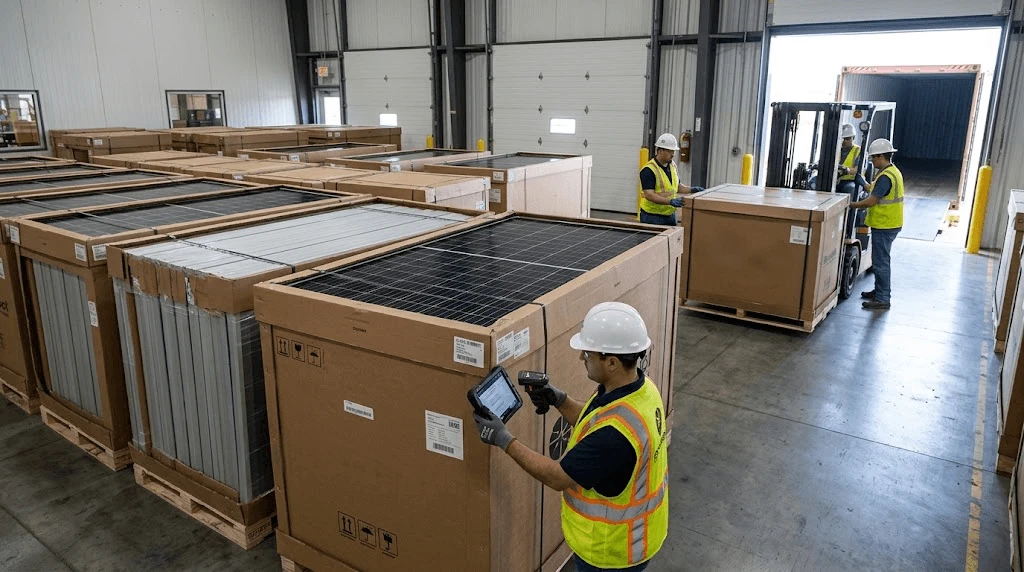
2. What specific export packaging standards are used to prevent micro-cracks and transit damage during long-distance ocean shipping?
Modules are packed vertically in reinforced double-wall corrugated boxes mounted on heavy-duty, heat-treated ISPM- 15-compliant wooden pallets. High-density corner protectors separate individual modules to eliminate glass-to-frame friction.
Pallets are wrapped in moisture-proof stretch film with embedded desiccant packs, banded with plastic-steel strapping, and secured inside ocean containers using corner-block bracing and air dunnage bags to prevent lateral movement during maritime transit.
3. What are the technical boundaries, lead times, and minimum order quantities (MOQ) for custom OEM/ODM module manufacturing?
OEM/ODM customization options cover cell size selection (M10, G12, G12R), busbar configurations (16BB to SMBB), frame dimensions/colors, custom cable lengths, and junction box connector types (MC4 compatible or original Stäubli).
Standard OEM engineering approval takes 10 to 14 business days for bill of materials (BOM) validation and line calibration. Lead time for mass production is typically 21 to 30 days after initial sample sign-off, with a standard MOQ of 1 MW per custom configuration.
Engineering Consultation & BOM Requests
Evaluating supplier reliability requires technical validation at the component level. Contact our engineering team for a customized 5kW PV system layout and detailed BOM quote within 48 hours.