
Heat Dissipation Strategies in 8kW Hybrid Inverters During Summer Peak
Examine advanced thermal management, adaptive thermal throttling, and derating curves for 8kW hybrid solar inverters in high-temperature climates.
Introduction
High ambient temperatures during summer peak operations present severe engineering challenges for residential and small commercial photovoltaic installations. Standard 8kW hybrid inverters frequently experience thermal stress, efficiency degradation, premature capacitor aging, and unexpected protective shutdowns when operating above 45°C ambient thresholds without robust thermal management. Inadequate heat dissipation directly compromises system availability, reduces inverter lifespan, and elevates the levelized cost of electricity (LCOE) through energy curtailment.
This technical guide details advanced thermal engineering strategies implemented in modern 8kW hybrid inverters to maintain optimal semiconductor junction temperatures under extreme thermal loads. Technical buyers will examine the mechanics of stratified air channel cooling, optimized internal fin geometry, adaptive thermal throttling algorithms, and precise derating temperature calibrations. Furthermore, this document provides quantifiable performance comparisons across cooling topologies, enabling EPC contractors and energy project officials to select reliable hardware engineered for high thermal resilience and long-term yield stability.
Technical Analysis and Core Mechanisms
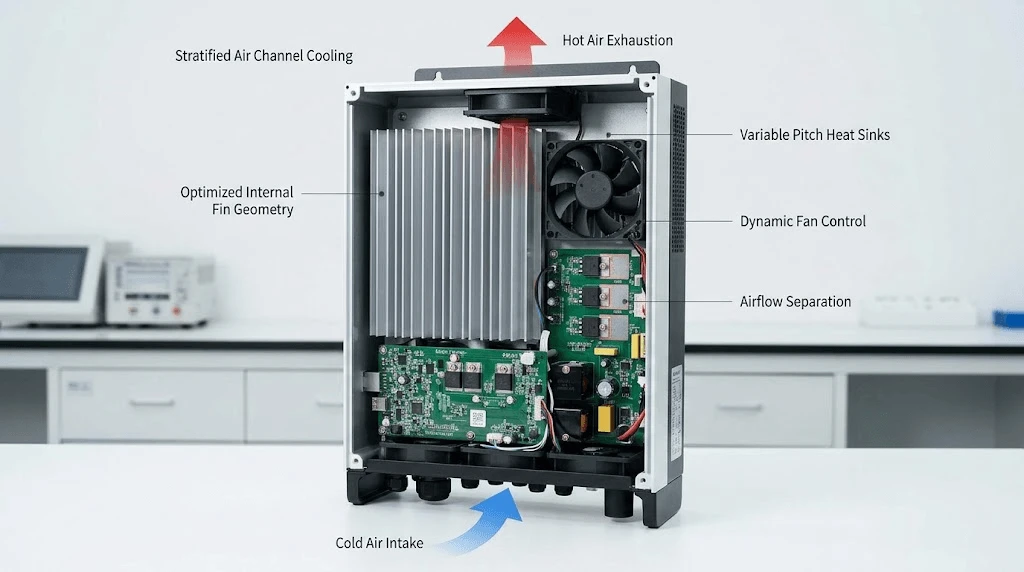
Modern 8kW hybrid inverters deployed in high-temperature environments rely on multi-tier thermal architectures to dissipate heat generated by power conversion stages, including Maximum Power Point Tracking (MPPT) circuits and DC/AC inversion blocks.
Internal Fin Geometry Optimization: Heat sinks utilize extruded aluminum alloys with high thermal conductivity coefficients (≈ 200 W/m.K). The fin array features variable pitch geometry, increasing surface area density near high-dissipation Insulated Gate Bipolar Transistors (IGBTs) and metal-oxide-semiconductor field-effect transistors (MOSFETs) while maintaining laminar airflow channels.
Stratified Air Channel Cooling: Thermal designs separate power electronics from sensitive control boards. High-heat components are housed in sealed or dedicated airflow compartments, protecting microcontrollers and communication modules from airborne particulate ingress and localized thermal saturation.
Adaptive Thermal Throttling: Rather than executing abrupt protective shutdowns during extreme temperature spikes, firmware employs adaptive thermal throttling. The system dynamically modulates switching frequencies and current output curves in linear increments once internal thermal sensors register component temperatures exceeding 75°C.
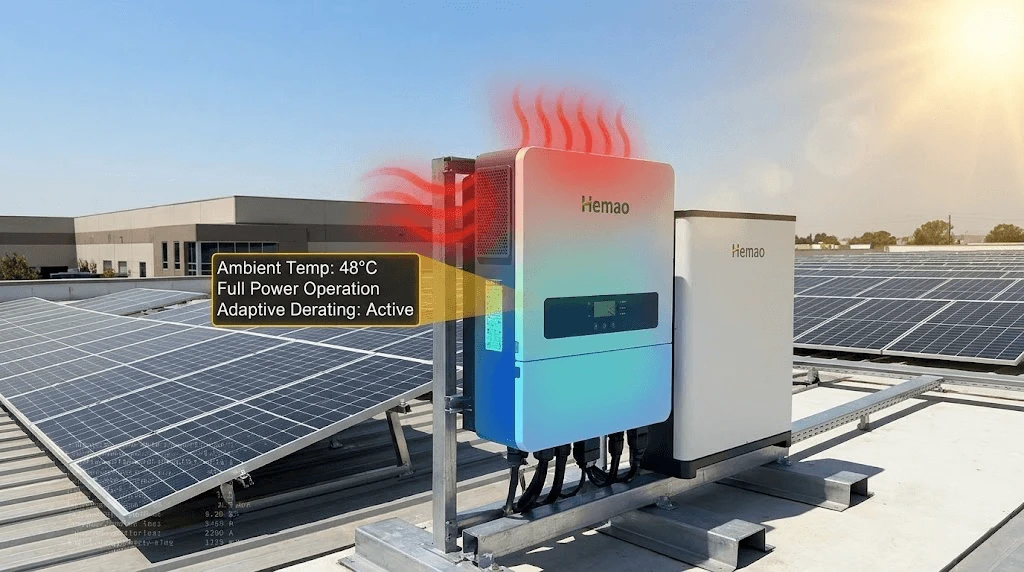
Derating Temperature Calibration: Factory-calibrated firmware profiles dictate exact power reduction thresholds. When ambient temperatures surpass the nominal design rating (typically 45°C), the inverter initiates controlled power derating based on real-time junction temperature feedback rather than crude ambient temperature estimations.
Industry Standards and ROI Impact
Thermal management directly dictates equipment reliability metrics, including Mean Time Between Failures (MTBF) and electrolytic capacitor endurance.
Thermal Topology Comparison Matrix
|
Cooling Topology |
Max Ambient Temp for Full Power |
Acoustic Noise Level |
Calculated MTBF (Hours) |
Electrolytic Capacitor Lifespan at 50°C |
|
Natural Convection (Passive) |
40∘C |
<30 dB(A) |
80,000 |
45,000 hours |
|
Standard Forced Air (Constant Fan) |
45∘C |
52 dB(A) |
65,000 |
35,000 hours |
|
Stratified Channel + Variable Speed Fan |
55∘C |
<40 dB(A) (Dynamic) |
120,000 |
85,000 hours |
ROI Impact Analysis
Deploying 8kW hybrid inverters equipped with advanced thermal management directly reduces lifecycle operational expenditure (OPEX). Electrolytic capacitor degradation doubles for every 10℃ increase above standard operating parameters. By maintaining lower internal operating temperatures through optimized fin geometries and intelligent airflow control, operators eliminate premature component failure events and costly replacement logistics. Furthermore, precise derating calibration prevents total system trips during peak solar generation hours, securing maximum daily kilowatt-hour yield and accelerating project payback periods.
System Integration and Compatibility
Within utility and commercial solar ecosystems hosted on hemaosolarpv.com, 8kW hybrid inverters must integrate seamlessly across the electrical balance of system (BoS).
·Photovoltaic Module Compatibility: The thermal design accommodates high-input DC voltage ranges (up to 1000V) and high current thresholds matching N-Type TOPCon PV modules (182mm and 210mm cell formats), preventing thermal runaway under high-irradiance conditions.
·Energy Storage Synergy: Thermal integration extends to LiFePO4 battery storage systems connected via high-speed CAN and RS485 communication protocols. The inverter dynamically shares thermal telemetry data with the Battery Management System (BMS), synchronizing charging currents to prevent compounded thermal stress during simultaneous high-power grid charging and peak solar harvest.
·Mounting and Enclosure Alignment: Units maintain IP65 ingress protection ratings, ensuring that forced-air cooling channels utilize dust-filtered intake valves that prevent moisture and saline particulate accumulation in coastal or high-humidity installations.
Quality Control and Global Compliance
Rigorous manufacturing quality control ensures field reliability across extreme operating environments:
1. Infrared Thermal Imaging Stress Testing: Every inverter undergoes full-load thermal profiling using high-resolution infrared cameras to verify the absence of localized hot spots on PCB traces and power terminals.
2. Accelerated Life Testing (ALT): Production batches are subjected to thermal shock chambers cycling between -40℃ and +85℃ over 500 consecutive hours.
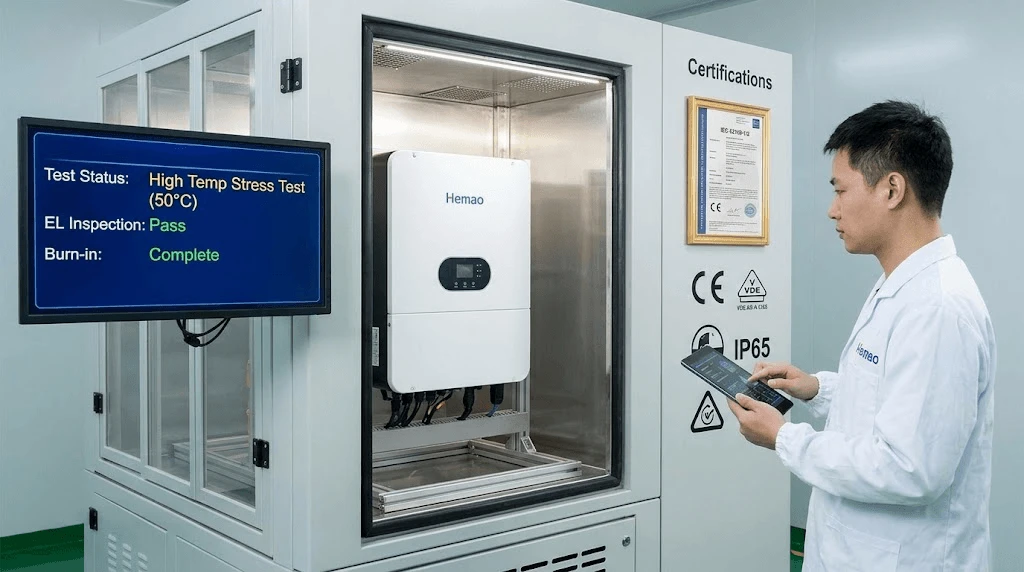
3. Burn-in Testing: Units undergo 48-hour continuous full-load operational burn-in testing at elevated ambient temperatures (50℃) prior to final packaging.
4. Global Compliance Certifications: Compliance verified under international standards including IEC 62109-1/2, IEC 61000, CE, and VDE-AR-N 4105 grid interconnection protocols.
FAQ
Q1: How do 8kW hybrid inverters maintain energy conversion efficiency under ambient temperatures exceeding 50°C in tropical or desert installations?
A: High-temperature performance is maintained through dual-stage thermal architecture combining high-density extruded aluminum heat sinks with intelligent variable-speed cooling fans. When ambient temperatures surpass 50°C, internal sensors trigger adaptive thermal throttling, optimizing switching frequencies to limit semiconductor junction temperatures without triggering total system shutdown.
Q2: What specific export packaging standards and vibration protocols protect internal heat sinks and electronic components during international ocean freight?
A: Units are secured within reinforced export-grade corrugated cartons paired with custom high-density expanded polyethylene (EPE) foam dampening inserts. Packaging designs undergo ISTA 2A drop and vibration testing to isolate internal PCB mounts, electrolytic capacitors, and heavy aluminum heat sink assemblies from shock impact during transit.
Q3: What are the technical parameters and lead times for OEM/ODM custom thermal profile configurations on high-capacity hybrid inverter units?
A: Custom thermal firmware profiles-including customized derating curves and trip-point calibrations for specialized industrial environments-are developed through the Hemao engineering division. Standard engineering validation requires 15 to 20 business days, followed by production implementation.
Endorsement & CTA
Contact the Hemao engineering team for a customized 8kW PV system layout and detailed BOM quote within 48 hours.