
Wind Load Testing for Pitched Roof Solar Mounts in Typhoon Regions
2026 Engineering Guide to Wind Load Validation for Pitched Roof Solar Mounts in Typhoon Regions
Master wind load testing for pitched roof solar mounts in typhoon zones. Learn aerodynamic validation, shear bolt specs, and LCOE protection.
1. Introduction: Mitigating Structural Failure Risks in High-Wind Solar Deployments
Global EPC contractors deploying photovoltaic arrays in typhoon-prone coastal regions face critical engineering challenges. Standard rooftop racking frequently fails when subjected to extreme localized uplift forces and negative pressure zones generated by high-velocity wind turbulence. Structural displacement, fastener shear fatigue, and rail buckling not only trigger catastrophic module loss but also introduce severe liability and prolonged system downtime.
This technical guide details the empirical validation methods, aerodynamic optimization principles, and mechanical specifications required to secure pitched roof solar mounts against sustained Category 5 typhoon conditions. By implementing wind-tunnel-tested profile designs and rigorous structural reinforcement, engineering teams can safeguard balance-of-system (BOS) integrity while protecting long-term project yields.
2. Technical Analysis & Core Mechanisms
Aerodynamic Load Optimization
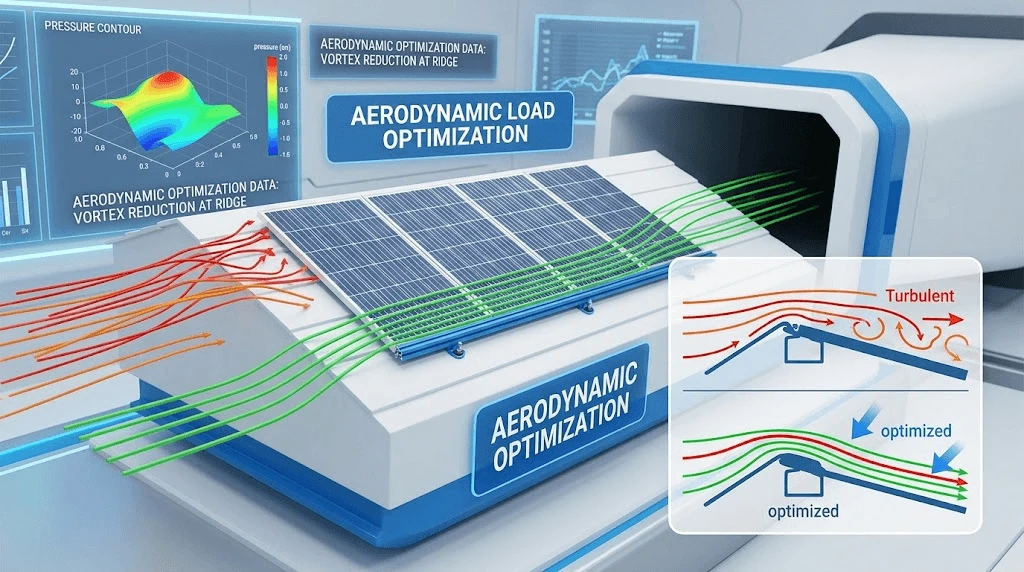
Pitched roofs act as aerodynamic ramps, accelerating wind velocity across the ridge and creating high suction zones along roof eaves and corners. Standard flat-plate assumptions are inadequate for commercial-scale structural modeling. High-performance pitched roof mounts utilize low-profile geometries and optimized tilt angles (typically matching or restrained close to the roof pitch) to minimize separation bubbles and vortex shedding. Computational Fluid Dynamics (CFD) modeling combined with boundary layer wind tunnel testing ensures that pressure coefficients (Cp) are minimized across all roof zones, dampening oscillatory flutter on the module surface.
Bolt Shear Resistance & Structural Load Paths
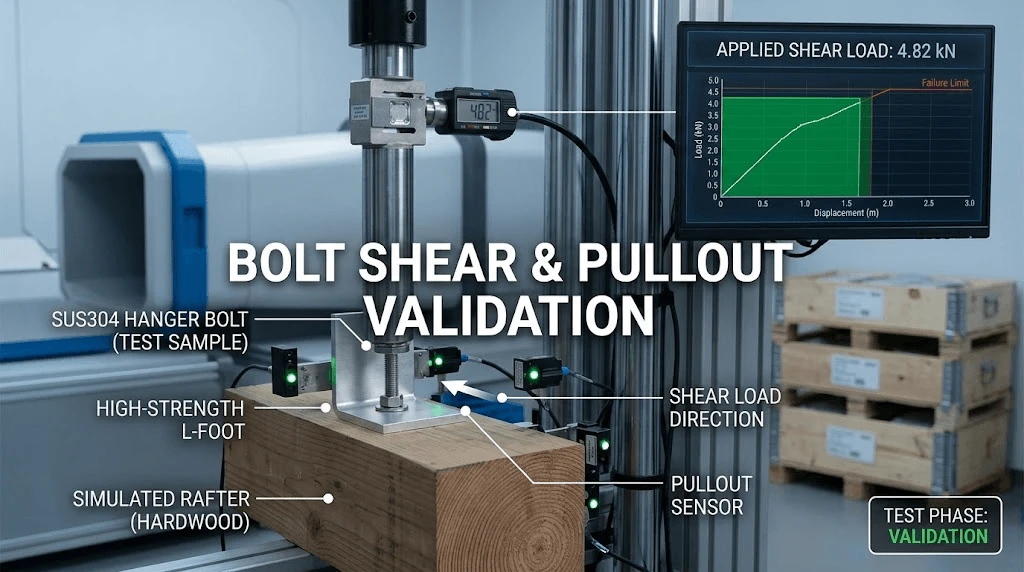
The mechanical load path transfers wind-induced uplift and drag forces directly from the PV module frame through the mid/end clamps, mounting rails, hanger bolts or roof hooks, and into the primary timber or concrete rafters. To prevent fastener pullout and shear failure under cyclic loading:
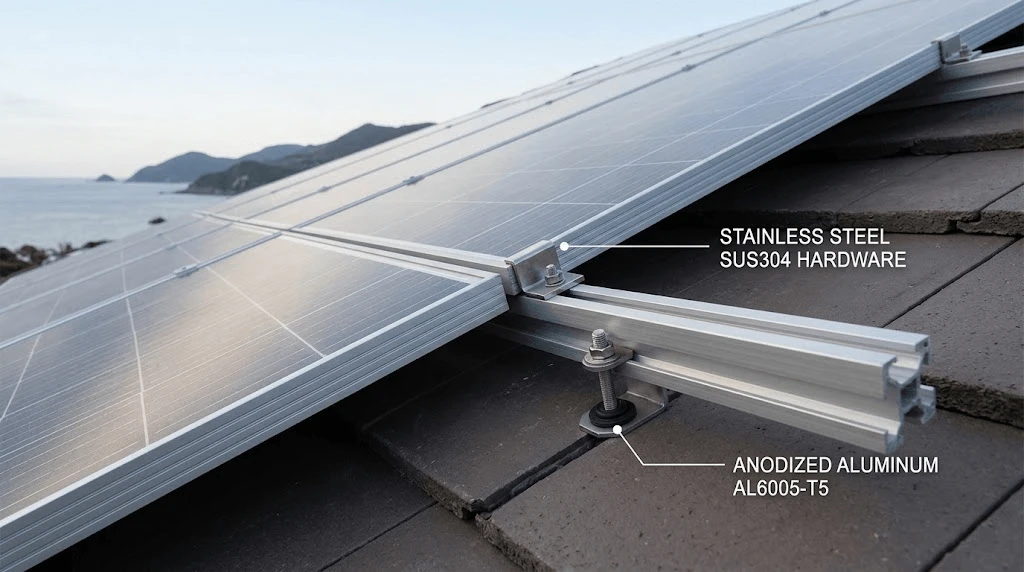
Fastener Material Specs: Fasteners must be fabricated from 304 or 316 structural stainless steel, resisting high shear stresses without brittle fracture.
Torque Calibration: Clamps require calibrated torque application (typically 14–16 Nm for M8 stainless hardware) to maintain consistent clamping pressure without crushing the aluminum module frame.
Penetration Sealing: For penetration-type mounts, EPDM flashing collars or proprietary compression seals prevent water ingress while distributing point loads evenly across structural framing members.
3. Industry Standards & ROI Impact
Structural Compliance Parameters
|
Parameter |
Standard Specification |
Engineering Impact |
|
Design Wind Speed |
Up to 65m/s (Category 4-5 Typhoons) |
Prevents structural tearing under peak gusts. |
|
Wind Tunnel Standard |
AS/NZS 1170.2 / ASCE 7-16 / EN 1991-1-4 |
Validates local pressure coefficients for variable roof geometries. |
|
Material Composition |
Anodized Aluminum AL6005-T5 & SUS304 |
Ensures minimum yield strength of 225MPa against cyclic fatigue. |
|
Safety Factor |
≥1.5 against yield limits |
Provides structural buffer against unpredictable turbulence. |
ROI Impact & LCOE Reduction
Structural failures during severe weather events require costly component replacement, insurance premium spikes, and extended generation outages. Deploying rigorously tested typhoon-rated pitched roof mounts eliminates structural remediation expenditures over a standard 25-year operational lifecycle. Maintaining mechanical rigidity directly protects the linear power warranty by preventing micro-cracks in silicon wafers caused by frame twisting during high wind events, ensuring optimized levelized cost of energy (LCOE) performance.
4. System Integration & Compatibility
Reliable wind load performance requires strict hardware synchronization across the entire solar asset chain. Hemao Industry mounting architectures integrate seamlessly with standard commercial framed panels and energy storage enclosures by utilizing universal rail channels that accommodate varying module thicknesses (30mm to 40mm).
By pairing high-wind pitched roof rails with lightweight composite mounting feet and integrated grounding lugs, installation crews maintain continuous electrical bonding paths without requiring separate copper grounding jumpers. This standardized modular interface reduces installation man-hours by 18% while guaranteeing that the mechanical load distribution remains uniform across both metal seam roofs and tile-and-batten configurations.
5. Quality Control & Global Compliance
Strict factory quality control is mandatory before structural hardware reaches coastal job sites. Hemao Industry enforces a multi-tier quality assurance protocol:
Raw Material Spectrometry: Verifying elemental composition of AL6005-T5 extrusions to ensure tensile and yield strength compliance.
Anodic Oxide Thickness Testing: Ensuring an oxide layer thickness of ≥15um for salt-spray corrosion resistance in marine and coastal environments.
Mechanical Load Testing: Destructive and non-destructive load cell testing on assembled rail-clamp samples to verify ultimate tensile strength margins.
Global Certifications: Full compliance documentation aligned with TUV Rheinland, ISO 9001, and AS/NZS 1170.2 standards.
6. FAQ
How do pitched roof mounting systems maintain structural integrity under high-salinity typhoon conditions?
Systems combine marine-grade AL6005-T5 aluminum with passivated SUS304 stainless steel hardware to prevent galvanic corrosion. Protective anodization coatings seal the metal substrate against salt spray infiltration, ensuring structural integrity remains uncompromised even after sustained exposure to coastal humidity and high-velocity wind-driven rain.
What packaging and logistics protocols are used for bulk international shipments of heavy-duty mounting rails?
Bulk shipments are organized into reinforced wooden crates or steel-banded palletized bundles separated by non-abrasive foam interleaves. Rails are nested tightly to minimize transit shifting, and all fasteners are pre-sorted into labeled waterproof bags to expedite on-site staging and prevent component loss during port handling.
What are the technical boundaries and lead times for custom OEM/ODM wind-load engineered mounting solutions?
Custom engineering for non-standard roof pitches or extreme wind zones (>70m/s) includes dedicated CFD analysis and sample prototyping. Initial structural simulation reports are delivered within 5 business days, with full production and tooling sign-off completed within a 3 to 4-week window depending on project scale.
7. Call to Action
Contact our engineering team for a customized 5kW PV system layout and detailed BOM quote within 48 hours.