
The B2B Solar Procurement Cycle: Aligning Technical Specifications
The B2B Solar Procurement Cycle: Aligning Technical Specifications, Tender Compliance, and Factory Audits
A technical guide for EPCs and distributors on aligning PV specifications, passing tender compliance, and executing factory audits to minimize LCOE.
Mitigating Risk in Utility and Commercial PV Sourcing
Procuring photovoltaic equipment for commercial and utility-scale projects involves technical, financial, and logistical complexities. EPC contractors, project developers, and regional distributors face system performance mismatches, non-compliance with regional grid codes, and supply chain delays that cause project overruns. A failure in module specification alignment, inverter communication compatibility, or structural engineering can lead to sub-optimal yield, higher Levelized Cost of Electricity (LCOE), and unexpected Operation and Maintenance (O&M) expenses.
This guide details the technical criteria required to navigate the B2B solar procurement cycle. By standardizing component evaluation, verifying tender compliance upfront, and executing rigorous factory audits, procurement teams can protect project yield and enforce strict quality control across the supply chain.
Datasheet Alignment and Electrical Parameters
Procurement errors frequently stem from reading datasheets under Standard Test Conditions (STC: 25°C cell temperature, 1000 W/m² irradiance, AM 1.5g spectrum) without accounting for Nominal Module Operating Temperature (NMOT) or real-world ambient extremes. Technical evaluation must analyze voltage curves, temperature coefficients, and degradation rates.
Electrical Specification Matching
1. Temperature Coefficient of Open-Circuit Voltage (Voc): High-efficiency N-type TOPCon and HJT modules maintain lower temperature coefficients (≈-0.26%/℃ to -0.29%/℃) compared to legacy P-type PERC (≈-0.34%/℃). In high-temperature regions (>40℃ambient), N-type technology limits voltage drop, maintaining higher power output at operating temperatures (Vmp).
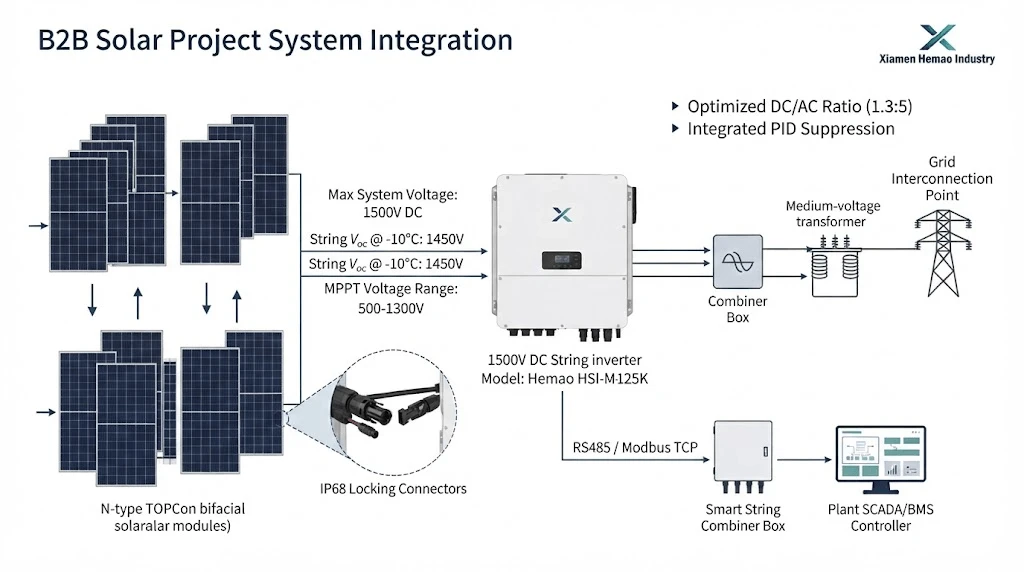
2. Cold-Weather String Sizing (Voc Max Calculation): Minimum historical site temperatures determine maximum string voltage. Neglecting the temperature coefficient at maximum cold conditions risks exceeding the 1000V or 1500V DC input threshold of the inverter, tripping protection circuits or destroying the DC input stage.
3. Bifaciality Factor and Rear-Side Gain: For ground-mounted utility sites using single-axis trackers, calculating rear-side irradiance gain (70% - 80% bifaciality factor) is mandatory to size DC/AC ratios correctly, select appropriate DC cabling, and avoid inverter clipping losses.
Industry Standards, Tender Compliance, and LCOE Impact
Tender compliance requires strict alignment with international safety, grid integration, and durability standards. Bidding documents for public utilities or private power purchase agreements (PPAs) specify mandatory testing parameters. Non-compliance leads to disqualification or costly post-installation retrofits.
Regulatory and Certification Matrix
|
Standard / Certification |
Scope & Test Focus |
Procurement Significance |
|
IEC 61215 / IEC 61730 |
Design qualification, type approval, and module safety construction. |
Baseline mandatory requirement for global project bankability. |
|
IEC 61701 / IEC 62716 |
Salt mist corrosion testing (Severity level 6) and ammonia resistance. |
Required for coastal, offshore, and agricultural ground-mount installations. |
|
UL 61730 / UL 1741 SB |
US safety standards for modules and smart inverters (including Rule 21/IEEE 1547-2018). |
Essential for North American grid interconnection and fire code compliance. |
|
IEC 62109-1/-2 |
Safety of power converters for use in photovoltaic power systems. |
Guarantees inverter isolation, insulation resistance, and fault protection. |
|
IEEE 1547 / EN 50549 |
Grid interconnection requirements, Low Voltage Ride Through (LVRT), frequency response. |
Prevents grid disconnection during transient voltage sags or utility fluctuations. |
LCOE Optimization through Specification Standards
Component specifications directly affect the project's financial metrics. Achieving the lowest LCOE requires balancing initial Capital Expenditure (CAPEX) against long-term energy yield and Operational Expenditure (OPEX).

·Linear Power Warranty Enforcement: Standardizing on 30-year linear warranties with ≤1.0% first-year degradation and ≤0.4% annual degradation directly protects the denominator (Yieldt) over the system lifecycle.
·Mismatch Loss Reduction: Specifying half-cut cell configurations and multi-busbar (MBB/SMBB) designs mitigates internal resistance (I2R losses) and reduces localized hot-spot impacts, lowering long-term O&M costs.
System Integration and Compatibility Analysis
Procuring individual high-performance components does not guarantee a high-performance system. System integration requires precise interface matching across the DC-to-AC balance of system (BOS).
Module-to-Inverter Compatibility
·DC Input Current Matching: Modern ultra-high-power modules (600W+) output short-circuit currents (Isc) exceeding 15A to 18A. String inverters must feature MPPT current capacities capable of handling high-current inputs without thermal throttling.
·Connector Compatibility: Interfacing different connector brands (e.g., standard MC4 with third-party clones) violates code compliance and introduces contact resistance. This causes thermal stress and presents an arc-fault risk. Original manufacturer connectors must be specified across all string jumpers.
Structural and Balance of Plant Integration
Tracker and Racking Mechanical Load: Modules must match structural racking hole dimensions and clamp zones certified for site-specific wind (up to 2400 Pa or snow loading (up to 5400 Pa). Dynamic wind tunnel testing reports are mandatory for single-axis tracker integration.
BMS and SCADA Protocols: For PV systems integrated with energy storage (BESS), inverter-to-BMS communication must support standardized protocols (Modbus TCP/RTU, CAN Bus) to maintain system response times for frequency regulation and peak shaving.
Explore localized project layouts and complete balance-of-system engineering on our Solutions and Services Page.
Factory Audits and Quality Assurance Framework
Procurement contracts must include factory acceptance testing (FAT) rights and third-party audit protocols. Visual inspections are insufficient; technical verification must occur during production line processing.
Factory Audit Checklist for Utility Procurement
1. Cell Sorting and Binning: Verify that the factory enforces strict current binning ($\pm 0.1\text{A}$ tolerance) before stringing to reduce inter-module mismatch losses in series strings.
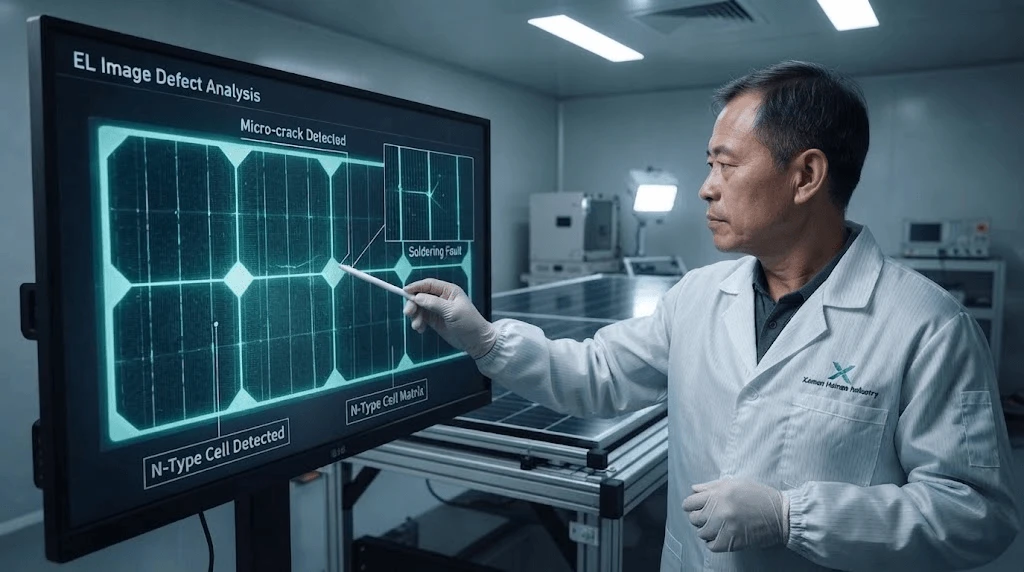
2.Double Electroluminescence (EL) Inspection: Require EL imaging both before lamination (to catch micro-cracks, broken grid lines, and cell gaps) and after lamination (to detect thermal stress damage caused by the lamination process).
3. Gel Content Test for Encapsulation: Audit the laboratory test records for lamination cross-linking density. EVA or POE encapsulants must achieve specified cross-linking ratios (>80%) to prevent delamination and Potential Induced Degradation (PID) in damp-heat conditions.
4. Flash Test Calibration: Ensure sun simulators used for flash testing are classified as Class AAA according to IEC 60904-9, with regular calibration against reference cells certified by independent laboratories (e.g., Fraunhofer ISE, TÜV Rheinland).

Technical FAQ: B2B Sourcing and Operations
1. How do TOPCon and HJT modules maintain performance in high-temperature, high-humidity environments?
N-type TOPCon (Tunnel Oxide Passivated Contact) and HJT (Heterojunction) technologies utilize passivated contacts and thin-film silicon layers that eliminate light-induced degradation (LID) and light and elevated temperature-induced degradation (LeTID). Their lower temperature coefficient (typically -0.26%/℃) reduces voltage losses at elevated temperatures (>45℃). Furthermore, dual-glass encapsulation with POE (Polyolefin Elastomer) films prevents moisture ingress, mitigating Potential Induced Degradation (PID) and acetic acid corrosion in high-humidity areas.
2. What packaging and transport standards are required to eliminate micro-cracks during long-distance maritime shipping?
To prevent transportation-induced micro-cracks, module packaging must comply with ISTA 3E or IEC 62759-1 dynamic mechanical load testing standards. Modules must be packed vertically on corner-protected, heavy-duty corrugated wooden or plastic pallets, strapped with high-tensile PET banding. Pallets must fit within 40ft HQ shipping containers without vertical stacking. Unloading procedures at the job site require a mechanical crane or specialized forklift attachments; manual side-tilting of pallets must be strictly prohibited.
3. What are the lead times and technical boundaries for custom OEM/ODM module manufacturing?
Custom OEM/ODM manufacturing-such as custom frame dimensions, specialized glass coatings, integrated MLPE (Module-Level Power Electronics), or specific cable lengths-typically requires a 6-to-10-week technical development cycle prior to mass production. This timeline includes 2 weeks for CAD drawing approval and Bill of Materials (BOM) freezing, 3 to 4 weeks for sample fabrication and preliminary IEC reliability pre-testing, and 2 to 4 weeks for tooling adjustability. Technical boundaries are dictated by the automated stringing equipment's cell size capacity (e.g., M10, G12 wafers) and lamination bed dimensions.
Technical Consultation and Engineering Quotes
Specifying the correct balance of equipment requires rigorous bill-of-materials (BOM) validation and system engineering support.
Contact our engineering team for a customized 5kW PV system layout and detailed BOM quote within 48 hours.