
Aluminum vs. Steel Solar Racking for Flat Commercial Roofs
Flat Roof Solar Mount Selection: Aluminum vs. Steel Commercial Racking Systems
Technical evaluation of anodized aluminum vs. galvanized steel racking for flat commercial roofs. Load analysis, corrosion ratings, and installation ROI.
Commercial flat roof PV installations face strict engineering constraints. EPC contractors and project engineers must balance static roof load capacity against wind uplift resistance, dynamic corrosion risks, and site labor costs. Selecting between extruded anodized aluminum and hot-dip galvanized steel framing directly dictates the Levelized Cost of Energy (LCOE) and the long-term structural integrity of the solar array.
This technical guide provides a comparative engineering analysis of anodized aluminum and galvanized steel racking systems for flat commercial roofs, focusing on dead-load limits, corrosion mitigation, pre-assembly efficiencies, and full life-cycle economics.
Technical Analysis & Core Structural Mechanisms
Selecting framing materials requires evaluating structural strength-to-weight ratios, wind uplift dynamics, and metal fatigue resistance.
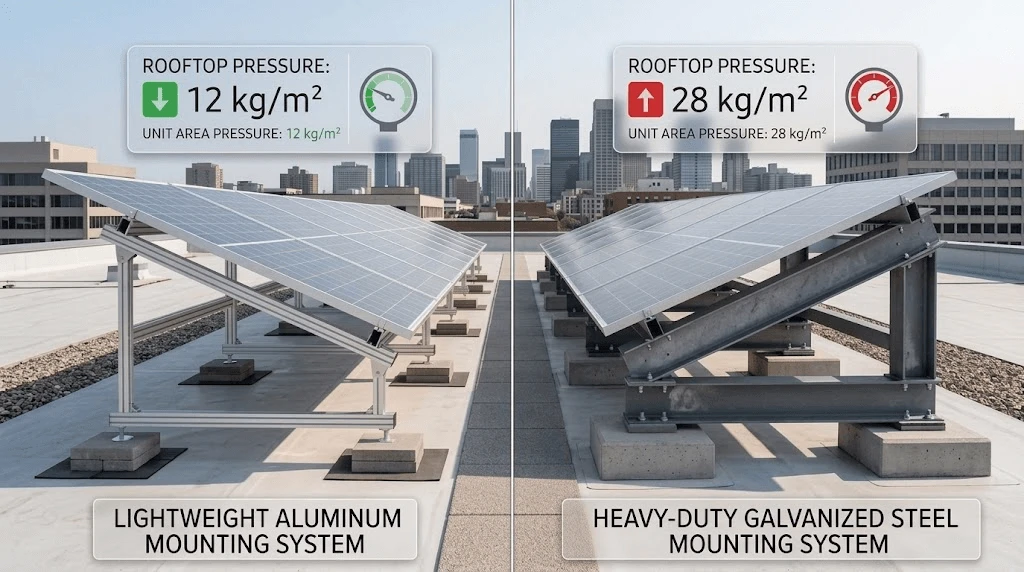
Extruded Anodized Aluminum (AL6005-T5)
AL6005-T5 aluminum alloys undergo artificial aging to yield a minimum tensile strength of 260 MPa and a yield strength of 240 MPa.
Weight Efficiency: Densities around 2.70 g/cm³ keep system dead loads (including panels and hardware) between 10 kg/m² and 15 kg/m². This minimizes structural reinforcement on low-capacity commercial roofs (e.g., lightweight steel-deck structures capped with TPO or EPDM membranes).
Anodization Layer: A standard anodization thickness of> 10 µm (Anodized Class 10 or 15) forms a non-porous aluminum oxide surface. This layer prevents environmental degradation and eliminates the need for field-applied protective coatings.
Hot-Dip Galvanized Steel (Q235B / Q355B)
Structural C-channel steel mounts utilize carbon steel hot-dip galvanized to ISO 1461 standards.
Structural Rigidity: Densities near 7.85 g/cm³ and yield strengths exceeding 355 MPa (for Q355B) provide stiffness against bending under heavy snow or extreme wind conditions (> 60 m/s).
Dead Load Drawbacks: Steel framing elevates system weight to 22–35 kg/m² (excluding concrete ballast blocks). This often exceeds structural thresholds on aged commercial buildings without costly structural under-deck retrofits.
Industry Standards, Material Metrics, and ROI Impact
Roof racking choices affect field installation velocity, thermal expansion mitigation, and total project ROI.

|
Engineering Parameter |
AL6005-T5 Anodized Aluminum |
Hot-Dip Galvanized Steel (HDG) |
Impact on Commercial PV Projects |
|
Material Density |
~2.70 g/cm³ |
~7.85 g/cm³ |
Lower weight reduces building structural stress and transport costs. |
|
Corrosion Protection |
Anodized Film (> 10 μm) |
HDG Coating (≥65μm or 450 g/m2) |
Aluminum prevents rust runoff that can damage roof membranes. |
|
Salt Spray Resistance |
ISO 9227 ASTM B117 (>2,000 hrs) |
ISO 9227 (1,000–1,500 hrs) |
Aluminum ensures structural stability in C4/C5 coastal zones. |
|
Pre-Assembly Index |
High (Integrated T-Clamps, Folding Arms) |
Moderate (Heavy bolted connections) |
Pre-assembled aluminum reduces field labor costs by up to 40%. |
|
Thermal Expansion |
23.1×10⁻⁶/K |
12.0×10⁻⁶/K |
Aluminum requires thermal expansion joints every 30 meters of continuous rail. |
|
Initial Material Cost |
Higher per kilogram |
Lower per kilogram |
Steel offers lower initial material costs for high-load installations. |
LCOE and Financial Impact
While hot-dip galvanized steel offers lower raw material costs per kilogram, aluminum racking reduces overall Balance of System (BOS) expenditure:
Labor Reduction: Pre-assembled aluminum components reduce field installation times from 0.35 man-hours/module to under 0.18 man-hours/module.
Logistics Savings: Aluminum's lower weight increases container packing density and lowers freight costs per megawatt.
Roof Maintenance: Aluminum prevents iron-oxide rust stains that degrade white TPO membranes and lower solar reflectivity.
System Integration and Compatibility
Integrating structural racking into commercial flat roofs requires precise alignment across structural, mechanical, and electrical subsystems.
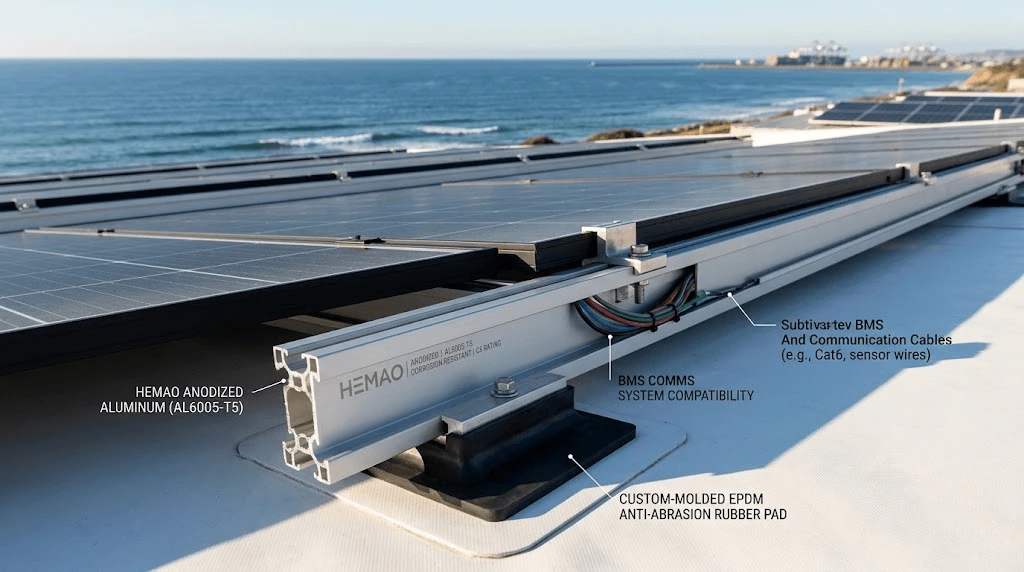
·Roof Membrane Compatibility: Aluminum ballast systems feature customized EPDM rubber pads beneath base channels. This isolates structural metals from direct contact with TPO, PVC, or EPDM membranes, preventing mechanical abrasion from micro-movements caused by thermal cycles.
·Module Clamping & Grounding Mechanisms: Mid-clamps and end-clamps incorporate integrated stainless steel (SUS304) grounding pins. These pins pierce the anodized film on module frames to establish continuity across the array, simplifying Equipment Grounding Conductor (EGC) runs.
·Structural Integration: For detailed component sizing, ballast calculations, and engineering drawings, review our technical specifications on Flat Roof Mount systems.
Quality Control and Global Compliance
Ensuring a 25-year structural service life requires rigorous testing and international certification.
Electroluminescence (EL) & Load Testing: Mechanical load testing according to IEC 61215 verifies structural resistance under dynamic wind pressures up to 2,400 Pa and snow loads up to 5,400 Pa.
Corrosion Testing: Accelerated salt spray testing under ISO 9227 and ASTM B117 confirms anodization stability in C4 and C5 coastal or industrial atmospheric zones.
Structural Compliance: Engineering designs must comply with AS/NZS 1170.2, Eurocode 1 (EN 1991-1-4), and UL 2703 safety standards covering rack mounting, grounding, and fire resistance.
FAQ
How do anodized aluminum racking systems perform in high-salinity coastal environments compared to galvanized steel?
In ISO 12944 C4/C5 coastal environments, hot-dip galvanized steel risks localized zinc coating depletion if salt spray accumulates, leading to red rust within 8 to 12 years. AL6005-T5 aluminum with a> 10 µm anodized layer forms an inert aluminum oxide surface. This layer resists atmospheric salt-fog degradation and prevents rust runoff, maintaining structural integrity over a 25-year lifespan without field recoating.
What are the transport packing standards and container loading capacities for large-scale aluminum mounting exports?
Pre-assembled aluminum flat roof systems are packed using steel-strapped wooden pallets, corner protectors, and moisture-sealed PE wrapping to prevent oxidation or friction damage during transit. The lower weight of AL6005-T5 maximizes 40-foot High Cube (40'HQ) container weight limits, allowing shipping densities of 3.5 MW to 4.5 MW of mounting hardware per container (depending on tilt angle and ballast design).
What are the technical limits for OEM/ODM structural customization on commercial flat roof projects?
OEM/ODM engineering options include custom tilt angles (5°to 30°), tailored ballast bay dimensions to fit non-standard concrete blocks, and variable leg profiles to meet specific local wind load requirements (> 60 m/s). Custom extrusion profiles require 10 to 14 days for die production and structural testing. Structural calculations and stamped engineering drawings can be prepared within 72 hours of receiving site-specific roof layouts.
Engineering Consultation & Project Quotes
Hemao Industry provides engineered structural mounting systems designed for commercial and industrial PV projects globally. Contact our engineering team for a customized 5kW PV system layout and detailed BOM quote within 48 hours.