
How Extreme Cold Affects LiFePO4 Battery Performance & Longevity
Technical Guide to Managing Low-Temperature Performance in Lithium Iron Phosphate (LiFePO4) Commercial Energy Storage Systems
Analyze cold-weather LiFePO4 battery degradation, self-heating mechanisms, and thermal-management strategies for commercial solar storage.
Introduction
Commercial and industrial photovoltaic installations operating in sub-zero environments face severe operational hurdles, particularly regarding energy storage degradation. When ambient temperatures drop below 0°C, standard Lithium Iron Phosphate (LiFePO4) cells experience a sharp increase in internal resistance and sluggish lithium-ion diffusion kinetics. Direct charging at freezing temperatures without adequate thermal regulation triggers irreversible lithium plating on the anode surface, leading to permanent capacity loss, sudden voltage drop, and shortened operational lifespan. For EPC contractors and project developers deploying multi-megawatt systems in high-latitude or alpine regions, these thermal vulnerabilities threaten project Internal Rate of Return (IRR) and Service Level Agreement (SLA) compliance. This technical brief examines the electrochemical mechanisms governing cold-weather battery degradation and outlines engineered mitigation strategies-including integrated self-heating matrices, advanced thermal management architectures, and low-viscosity electrolyte formulations-to ensure reliable winter operation and long-term asset security.
Technical Analysis / Core Mechanisms
At temperatures below 0°C, the ionic conductivity of standard organic liquid electrolytes in LiFePO4 cells declines exponentially, while the solid electrolyte interphase (SEI) layer thickens, restricting Li-ion transport between electrodes. During low-temperature charging, the potential of the graphite anode drops below the lithium deposition potential (0 V vs. Li/Li+), causing metallic lithium to precipitate as dendrites rather than intercalate into the carbon layers.
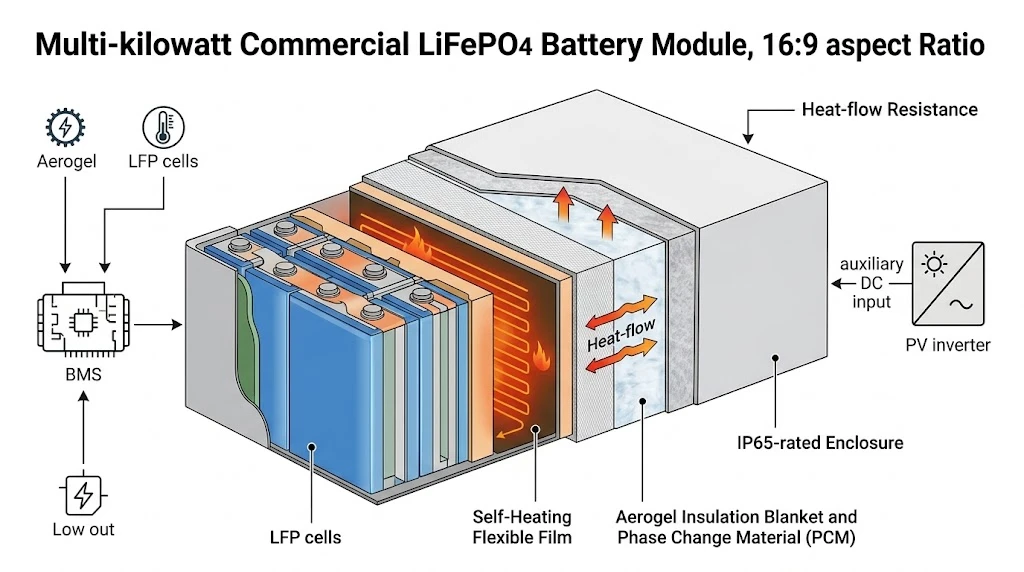
To counteract these degradation pathways, Xiamen Hemao Industry integrates a three-tier thermal defense mechanism:
1. Built-In Self-Heating Matrix: Dual-film flexible heating elements powered by auxiliary DC sources or direct PV surplus activate when internal temperature sensors record thresholds below 5°C. This pre-heating phase raises cell core temperatures to the optimal electrochemical window (15°C to 25°C) before charging initiation.
2. Dynamic Thermal-Management Architecture: Aerogel thermal insulation blankets combined with phase change materials (PCMs) encase the battery rack, minimizing thermal bridging and maintaining stable internal temperatures during high-ampere discharge cycles in sub-zero ambient conditions.
3.Low-Viscosity Electrolyte Formulations: Proprietary multi-component solvent blends reduce ionic liquid viscosity at -20°C, maintaining high ionic conductivity and preserving Coulombic efficiency even without external thermal input.
Industry Standards & ROI Impact
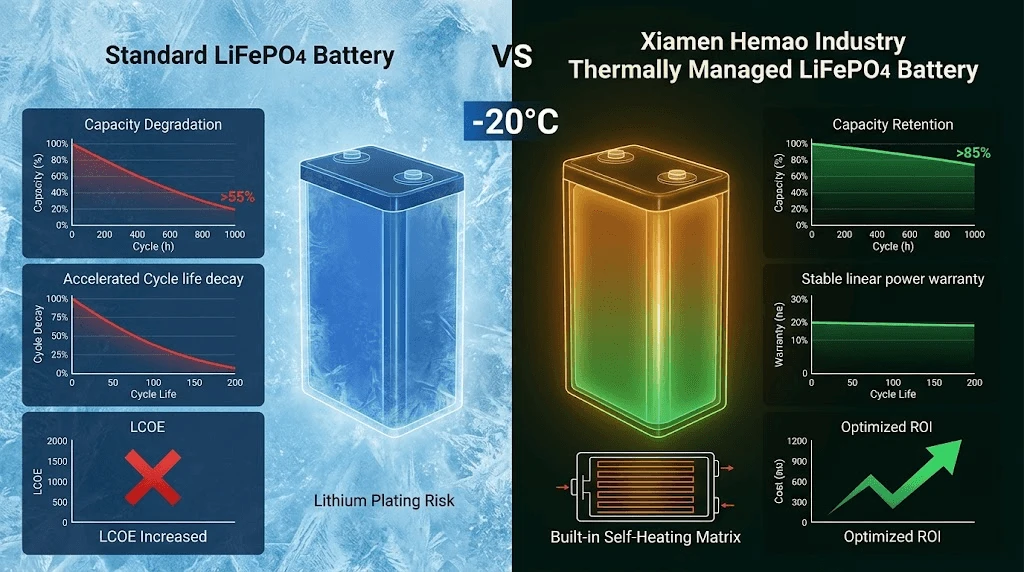
Deploying weather-hardened storage infrastructure directly alters the financial metrics of commercial photovoltaic assets. Below is a comparative performance matrix of standard versus thermally managed LiFePO4 battery systems under -20°C operational constraints.
|
Performance Parameter |
Standard LiFePO4 Battery |
Thermally Managed LiFePO4 (Hemao System) |
|
Available Capacity at -20°C |
45% - 55% of nominal rated capacity |
85% - 92% of nominal rated capacity |
|
Charge Efficiency (at -10°C) |
60% (Risk of lithium plating) |
95% (Controlled via self-heating pre-charge) |
|
Cycle Life Degradation (Winter Operation) |
35% accelerated capacity fade per year |
< 3% annual degradation (Linear warranty protected) |
|
LCOE Impact |
Increased replacement frequency ($/kWh up 40%) |
Optimized LCOE through extended 6,000-cycle lifespan |
ROI Analysis
Cold-weather capacity fade forces oversized installations and frequent battery bank replacements, driving up the Levelized Cost of Electricity (LCOE). By maintaining nominal operating temperatures through parasitic-optimized self-heating circuits (consuming less than 3% of total stored daily energy), asset owners prevent premature capacity degradation. This preserves the 10-year linear power warranty, reduces capital expenditure on replacement hardware, and secures contractual power purchase agreement (PPA) revenue streams.
System Integration & Compatibility
System integration across the photovoltaic balance-of-system (BoS) requires precise hardware and software synchronization. The battery management system (BMS) communicates via CAN 2.0B and Modbus TCP protocols directly with hybrid string inverters and meteorological monitoring stations. When ambient sensors detect dropping temperatures, the BMS preemptively signals the inverter to allocate auxiliary PV generation toward the battery heating film before bulk charging commences. Furthermore, physical installation compatibility with standard mounting structures and IP65-rated outdoor enclosures ensures safe deployment alongside commercial PV panels and high-voltage combiner boxes. For specific residential or small-scale commercial retrofits, the modular 12V 100AH Battery configuration offers identical low-temperature resilience and scalable parallel-series connectivity.
Quality Control & Global Compliance
Rigorous manufacturing quality control protocols validate long-term reliability in harsh operating environments:
Electroluminescence (EL) & Internal Resistance Testing: 100% cell-level screening to detect micro-cracks and baseline impedance variations.
Thermal Shock & Thermal Cycling Tests: Exposure to rapid temperature swings from -40°C to +85°C for 500 consecutive hours to verify weld integrity and seal durability.
Cell Aging & Capacity Sorting: 72-hour constant current/constant voltage (CC/CV) high-temperature aging followed by capacity matching within a strict ±1% tolerance band.
Global Certifications: Manufactured in compliance with UL 1973, IEC 62619, UN 38.3, and CE standards for international grid-tied and off-grid deployment.
FAQ
Q1: How does the internal self-heating mechanism perform under extreme sub-zero conditions (e.g., -30°C)? Can it draw power directly from the PV array without grid support?
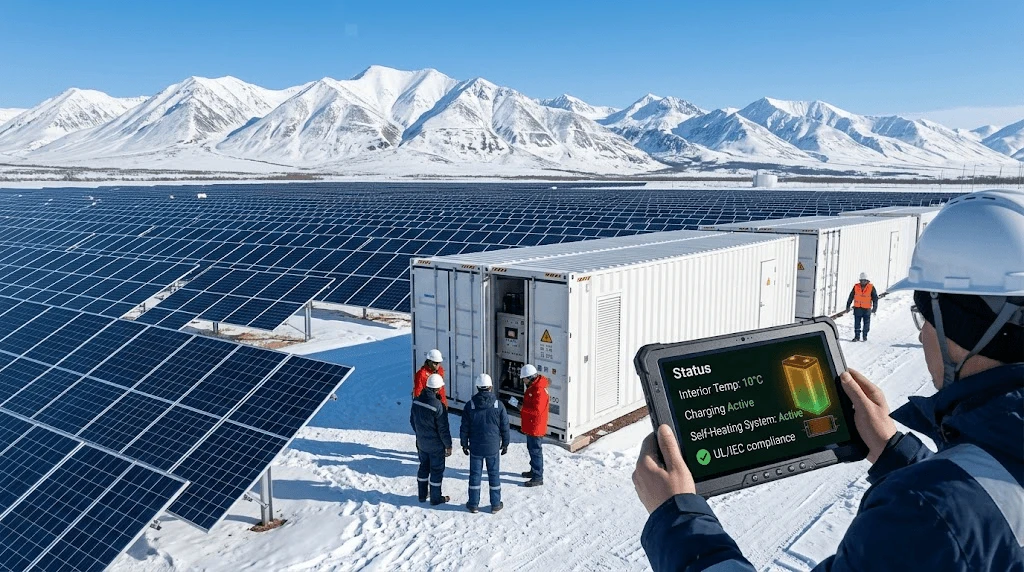
A: At ambient temperatures of -30°C, the embedded dual-film heating elements draw regulated DC power either from auxiliary grid feeds or directly from the PV strings via an isolated DC-DC converter. The BMS prioritizes thermal conditioning, raising cell core temperatures at a controlled rate of 1°C to 2°C per minute until reaching the safe charging threshold of 5°C. Once attained, main charging contactors engage safely, preventing lithium dendrite formation and ensuring full rated capacity retrieval.
Q2: What specific packaging and logistics protocols are implemented for bulk international ocean freight of LiFePO4 battery modules?
A: Bulk export shipments adhere strictly to UN 38.3 dangerous goods regulations. Battery modules are transported at a controlled State of Charge (SoC) between 30% and 50% to minimize chemical reactivity. Enclosures are packed in heavy-duty UN-certified wooden crating lined with moisture-barrier vacuum-sealed foil and shock-absorbing EPE foam blocks, ensuring compliance with IMO maritime shipping safety codes and preventing transit vibration damage.
Q3: What is the typical lead time and technical boundary for OEM/ODM custom thermal management configurations?
A: Standard OEM/ODM prototyping for custom voltage ratings, enclosure IP ratings, and tailored BMS heating algorithms requires 30 to 45 days from engineering sign-off to sample delivery. Technical boundaries include operating temperature lower limits of -40°C, custom communication protocol integration (such as proprietary SNMP or DNP3), and dimensional adjustments matching specific containerized energy storage system (CESS) rack designs.
Authority & Call to Action
Contact our engineering team for a customized 15kW PV system layout and detailed BOM quote within 48 hours.