
IP65 vs IP67: Selecting Waterproof Solar Lighting for Public Infrastructure
Compare IP65 and IP67 waterproof solar lighting for public infrastructure. Engineering guide for municipal EPCs on weatherproofing, enclosure sealing, and ROI.
Introduction
Municipal infrastructure projects deployed in coastal regions, high-precipitation zones, and arid dust-belt areas face premature hardware failure primarily driven by moisture ingress, thermal shock, and particulate accumulation. Traditional luminaire housings often fail within 18 to 36 months due to seal degradation under cyclic thermal expansion, leading to internal short circuits, optical lumen depreciation, and costly replacement cycles for municipal authorities and EPC contractors.
This technical guide provides a rigorous engineering comparison between IP65- and IP67-rated outdoor solar lighting systems. By examining internal sealing mechanisms, pressure-equalization dynamics, and field-performance data under extreme precipitation and wind-driven dust, this document establishes clear selection criteria for large-scale public infrastructure deployment. Internal links, such as Solar Path Lights, provide direct access to compliant system configurations.
Technical Analysis / Core Mechanisms
The ingress protection (IP) rating system, governed by IEC 60529, defines the exact defense capabilities of electrical enclosures against solid foreign objects and liquids. For municipal outdoor solar lighting, choosing between IP65 and IP67 determines the luminaire chassis and internal components' (LED drivers, MPPT charge controllers, and battery packs) protection level.
IP65 Enclosure Architecture
Solid Protection (Level 5): Dust-tight. Complete protection against contact and ingress of dust particles under normal operational conditions.
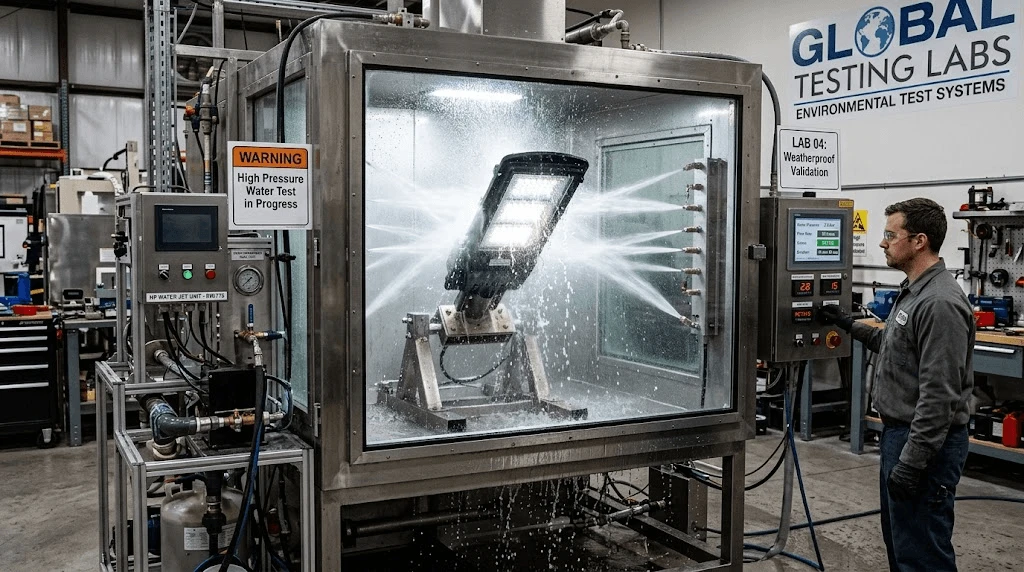
Liquid Protection (Level 5): Protected against water jets projected by a nozzle (6.3mm) from any direction. Water volume is 12.5liters/minute at a pressure of 30 kPa at a distance of 3 meters for a minimum of 3 minutes.
Engineering Realization: IP65 fixtures utilize multi-tiered EPDM rubber gaskets compressed via stainless steel mechanical fasteners along housing seams. Gasket longevity depends on compression set resistance under ultraviolet (UV) radiation and daily thermal cycling ranging from -20℃ to 60℃.
IP67 Enclosure Architecture
Solid Protection (Level 6): Dust-tight. Complete particulate exclusion, verified via negative pressure testing chambers.
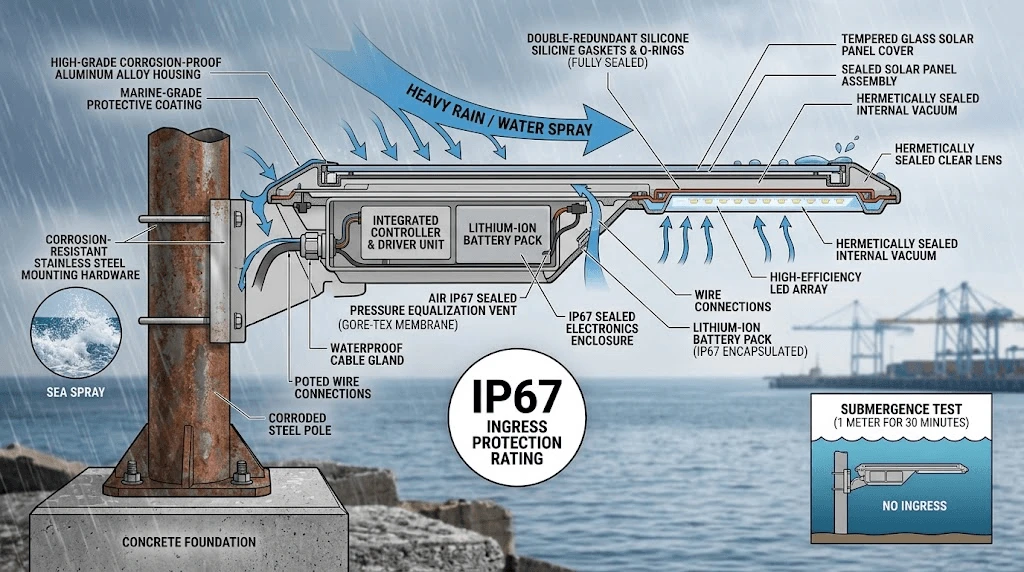
Liquid Protection (Level 7): Protected against the effects of temporary immersion in water up to 1 meter depth for 30 minutes. Test parameters require the lowest point of the enclosure to be 1000mm below the surface, or the highest point 150 mm below, whichever is deeper.
Engineering Realization: IP67 fixtures incorporate laser-welded structural aluminum housings, continuous polyurethane pouring gaskets, and integrated Gore-Tex breathable vent membranes. These vents permit molecular-level vapor permeability while blocking liquid water droplets and particulate matter, preventing destructive internal condensation caused by diurnal temperature swings.
Industry Standards & ROI Impact
Comparative Engineering Parameters
|
Parameter |
IP65 Outdoor Solar Lighting |
IP67 Outdoor Solar Lighting |
|
Dust Ingress Protection |
Complete (Dust-tight) |
Complete (Dust-tight under negative pressure) |
|
Moisture Resistance |
Water jet resistant (30kPa spray) |
Temporary immersion (1 m depth, 30 min) |
|
Housing Construction |
Cast aluminum with EPDM compression gaskets |
Extruded aluminum / laser-welded with breathable membrane |
|
Typical Deployment Zone |
Urban pedestrian zones, moderate rainfall regions |
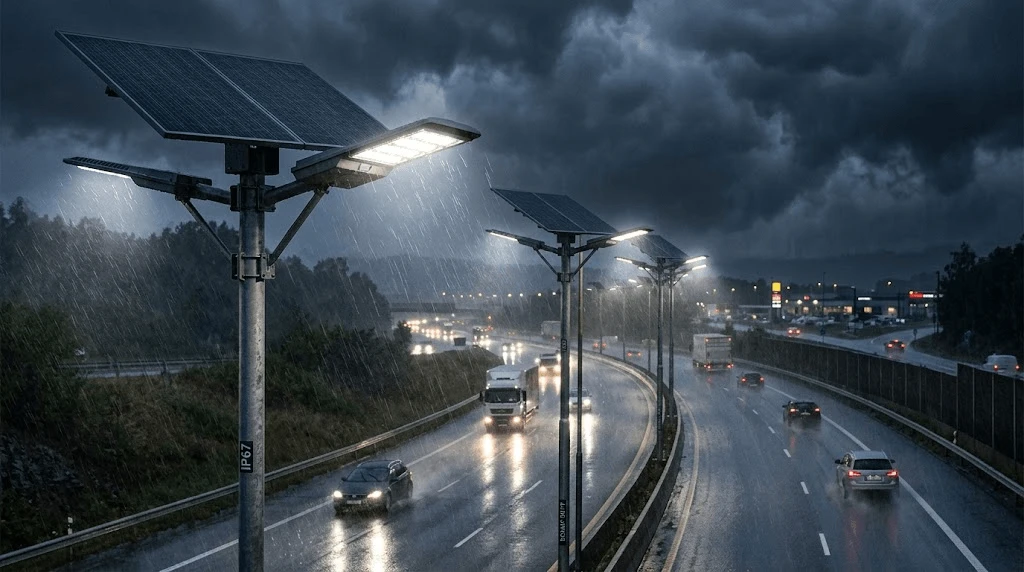
Coastal highways, flood-prone areas, high-dust basins |
|
Design Life Span |
5 – 7 years |
8 – 12 years |
|
Annual Maintenance Rate |
3.5% – 5.0% field failure rate |
< 0.8% field failure rate |
ROI and LCOE Impact
For public infrastructure projects backed by municipal bond financing or international development bank loans, Levelized Cost of Electricity (LCOE) and Total Cost of Ownership (TCO) dictate procurement decisions.
While IP67-rated fixtures carry an initial bill-of-materials (BOM) cost premium of 12% to 18% compared to IP65 alternatives, their deployment in severe environments eliminates recurring truck-roll maintenance expenses. In coastal zones subject to torrential monsoon rains and salt spray, IP65 gasket degradation typically triggers water ingress within 36 months, requiring emergency component replacement. Conversely, IP67 sealed enclosures maintain dry internal operating environments, extending battery life by avoiding electrolyte contamination and reducing 10-year project operational expenditure (OPEX) by up to 34%.
System Integration & Compatibility
Outdoor solar lighting infrastructure does not operate in isolation; it functions as a distributed node within a broader renewable energy network managed by EPC contractors.
Xiamen Hemao Industry integrates waterproof luminaire heads with scalable photovoltaic generation and storage links:
PV Module Integration: Monocrystalline half-cut cell panels (21.5% module efficiency) matched with adjustable tilt mounting structures to optimize solar irradiance capture.
BMS & Energy Storage Link: Lithium Iron Phosphate (LiFePO4) battery packs housed within auxiliary IP67 waterproof subsurface or pole-mounted enclosures, featuring RS485 / CAN communication protocols for remote telemetry.
Electrical Interconnects: IP67-rated waterproof quick-disconnect plug-and-play connectors prevent galvanic corrosion and terminal oxidation across extended cabling runs. For detailed pathways, consult our Solar Path Lights integration manual.
Quality Control & Global Compliance
Rigorous quality assurance protocols at Xiamen Hemao Industry ensure zero-defect manufacturing batches for utility-scale public tenders:
Ingress Protection Verification: Every production lot undergoes pressure testing chambers and immersion testing baths per IEC 60529 standards.
Environmental Stress Screening (ESS): Thermal shock chambers cycle units between -40℃ and +85℃ for 500 consecutive hours to stress-test seal integrity.
Salt Spray Corrosion Testing: ASTM B117 salt fog exposure testing for 1,000 hours to validate exterior powder coating and anodized aluminum passivation.
International Certifications: CE, RoHS, ISO9001 quality management systems, and IEC 60598-2-3 luminaire compliance documentation provided for project bidding dossiers.
FAQ
1. How do IP65 and IP67 solar lighting systems perform under high-salinity coastal environments and extreme thermal shock?
Coastal installations expose luminaires to airborne chloride ions combined with high UV radiation and extreme surface temperature swings (> 50℃ difference between day and night). IP65 fixtures with standard rubber gaskets experience rapid elastomer hardening, leading to micro-gaps through which salt-laden moisture is drawn in via internal cooling vacuums. IP67 systems mitigate this via marine-grade anodized aluminum alloys, fluoroelastomer seals, and pressure-equalizing hydrophobic micro-vents that neutralize internal vacuum pressure without letting in liquid brine or salt crystals.
2. What are the specific logistics packaging protocols for bulk international shipping of IP67 solar lighting systems?
For containerized export of high-volume public infrastructure orders, Xiamen Hemao Industry utilizes ISPM 15-compliant heat-treated wooden crates and multi-layer corrugated master cartons reinforced with moisture barrier films and desiccant sachets. Luminaire heads, battery enclosures, and pole brackets are modularly packed to eliminate transit vibration abrasion, ensuring that the factory-sealed IP67 enclosure integrity remains uncompromised upon arrival at port.
3. What is the technical boundary and lead time for OEM/ODM customization of public lighting enclosures?
Custom engineering for municipal projects (including bespoke wattage outputs, integrated microwave motion sensors, IoT LoRaWAN/NB-IoT smart city controllers, and specialized RAL color powder coating) operates within strict technical boundaries. Tooling modifications for die-cast housings require 30 to 45 days, while software integration and firmware flashing take 10 to 15 days. Full prototype validation and wind-tunnel structural verification are completed within a 60-day window prior to mass production sign-off.
Call to Action
Contact our engineering team for a customized 10kW PV system layout and detailed BOM quote within 48 hours.