Fire Safety Protocols for Commercial LiFePO4 Energy Storage Racks
Explore multi-tier fire safety protocols for C&I LiFePO4 battery racks, including thermal runaway suppression and NFPA 855 compliance.
Energy storage fire, C&I battery rack, Thermal Runaway Suppression, Zoned Fire Containment, Early Thermal Pre-Alarm
Introduction
Commercial and industrial energy storage systems face severe operational risks, including thermal runaway propagation, stringent regulatory compliance audits under NFPA 855 and UL 9540A, and significant financial liabilities from catastrophic battery pack failures. Traditional fire suppression systems often react too late, allowing single-cell failures to cascade across entire rack arrays.
This technical guide outlines a multi-tiered fire safety architecture engineered for commercial LiFePO4 energy storage racks. We examine the operational mechanics of early thermal pre-alarms, active aerosol fire suppression deployment, and zoned physical thermal barriers designed to restrict propagation within specific module boundaries. By integrating precise battery management system (BMS) signal linkages with automated HVAC shutdowns, EPC contractors and system integrators can mitigate fire risks, secure regulatory approvals, and protect long-term capital expenditure returns without sacrificing round-trip efficiency.
Technical Analysis & Core Mechanisms
Protecting high-density energy storage deployments requires a multi-layered defense strategy operating at the cell, module, and rack levels.
1. Early Thermal Pre-Alarm Architecture
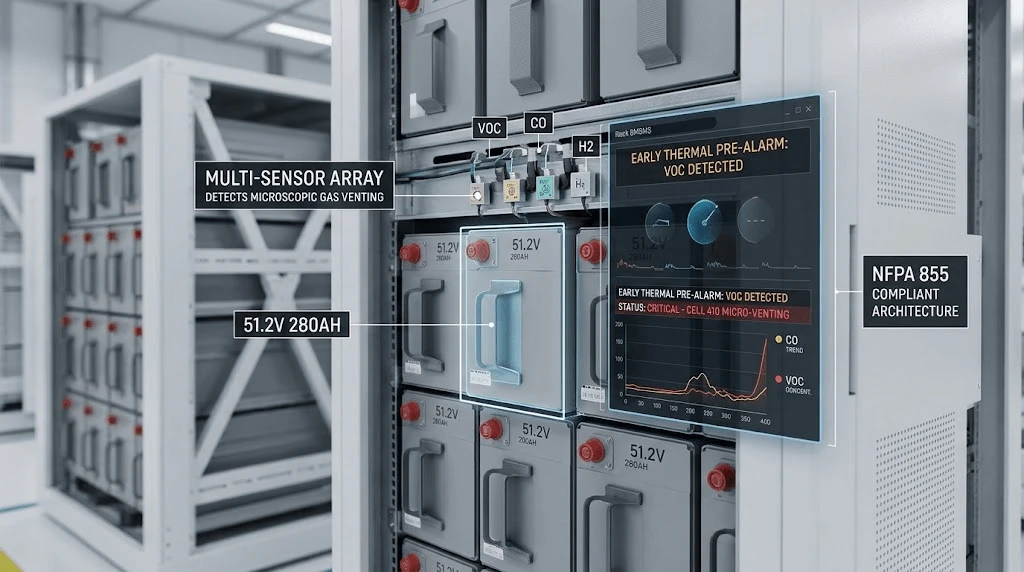
Standard smoke detectors react after combustion has already begun, which is often too late in dense lithium-ion enclosures. Modern C&I battery racks utilize dual-sensor off-gas detection architectures. By measuring volatile organic compounds (VOCs), carbon monoxide (CO), and hydrogen (H2) concentrations within the closed battery compartment, the system identifies micro-venting events up to 15 minutes before thermal runaway occurs. This early warning triggers immediate interlock actions, isolating the affected rack via high-speed DC contactors long before thermal runaway reaches critical temperatures.
2. Zoned Fire Containment and Thermal Barriers
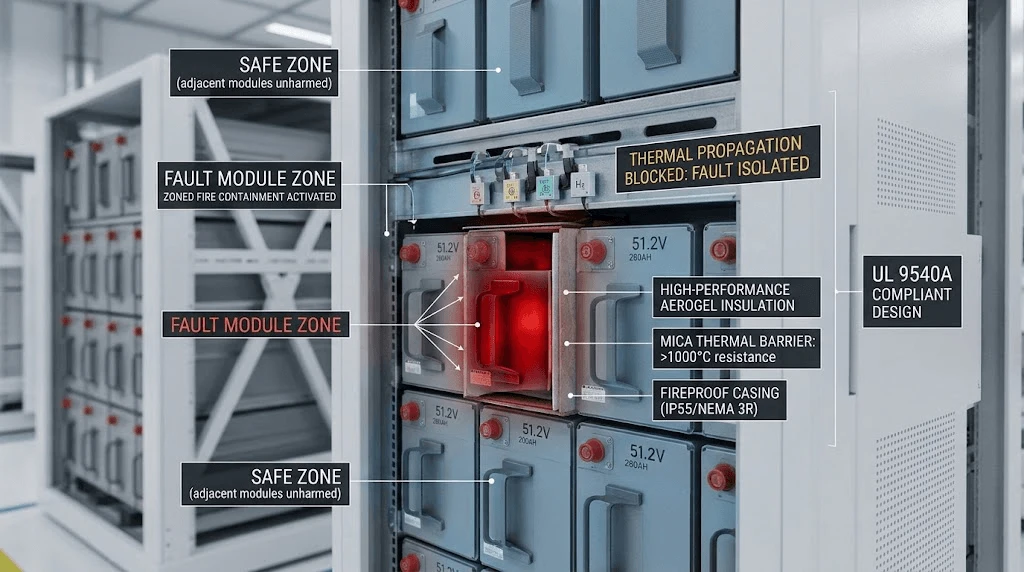
To prevent cascading cell-to-cell thermal propagation, individual module trays within the rack are separated by high-performance aerogel insulation blankets and proprietary mica-based thermal barrier plates. These materials withstand temperatures exceeding 1000℃ for a minimum of 30 minutes, confining any localized thermal event to a single sub-rack module and protecting adjacent 51.2V 280AH battery clusters from secondary activation.
3. Active Aerosol Fire Suppression
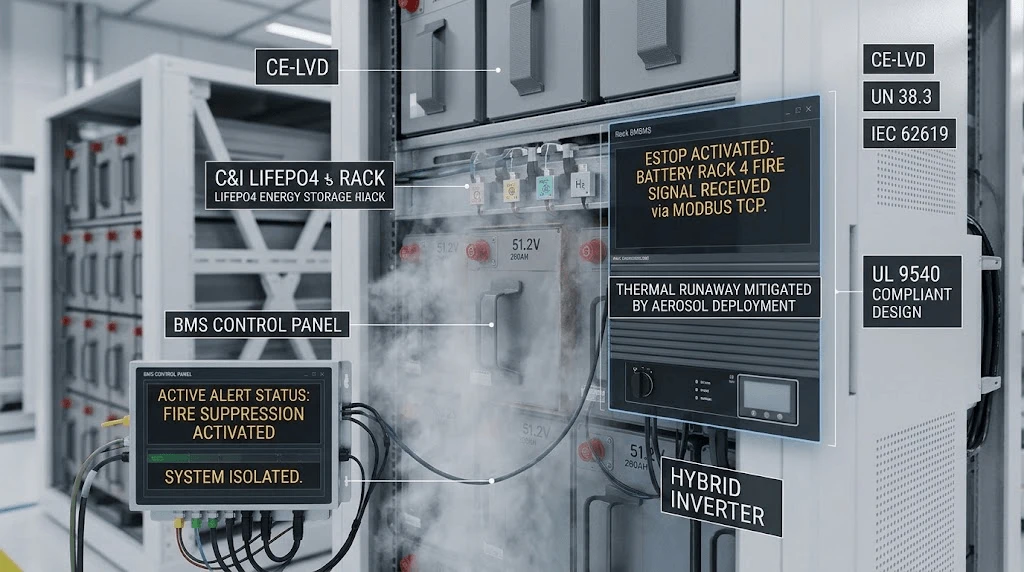
Upon validation of an active thermal anomaly by the BMS logic controller, local aerosol generators deploy potassium-based condensed aerosol agents directly into the affected rack zone. Unlike pressurized water systems-which present high electrical short-circuit hazards-aerosol agents interrupt the chemical chain reaction of the fire by neutralizing free radicals in the gas phase, extinguishing the fire within seconds while leaving sensitive electronics undamaged by water residue.
Industry Standards & ROI Impact
Adhering to rigorous engineering benchmarks ensures project bankability and lowers the total cost of ownership (LCOE) for utility-scale and commercial microgrids.
|
Performance Parameter |
Standard Commercial Rack |
Xiamen Hemao Advanced C&I Rack |
|
Early Gas Detection Time |
Post-combustion (Smoke/Heat) |
15 minutes pre-runaway (Off-gas VOC/CO) |
|
Thermal Barrier Rating |
600∘C for 15 minutes |
1,000∘C for 30 minutes |
|
Suppression Activation Speed |
30 to 60 seconds |
Sub-10 seconds (Aerosol deployment) |
|
NFPA 855 Compliance |
Partial / Retrofit dependent |
Fully integrated compliant design |
|
System Availability Impact |
High risk of total rack write-off |
Isolated zone containment (zero array downtime) |
ROI Impact on LCOE
Investing in advanced multi-tier fire safety directly influences project financial returns. By isolating faults to individual modules rather than sacrificing an entire 100kWh–5MWh container, replacement expenditures (OpEx) drop by over 80% during a fault event. Furthermore, meeting strict insurance underwriting criteria mandated by NFPA 855 and UL 9540 significantly reduces annual property and casualty insurance premiums, lowering the levelized cost of storage (LCOS) and improving project internal rate of return (IRR) profiles for investors.
System Integration & Compatibility
Reliable energy storage depends on synchronized hardware interfaces across the entire photovoltaic balance of plant. Xiamen Hemao Industry designs commercial energy storage racks for direct integration within existing solar PV infrastructures.
· Inverter Communication: The rack-level BMS communicates directly with hybrid and central inverters via CAN 2.0B and Modbus TCP protocols, enabling real-time derating or emergency shutdown signals when thermal anomalies are detected.
· Rack Architecture: Standardized 51.2V 280AH rack modules feature modular plug-and-play high-voltage DC busbars and liquid/air cooling manifolds that maintain cell temperature differentials within ±2℃, mitigating thermal stress accumulation.
· Environmental Sealing: Cabinets feature IP55/NIP 3R enclosures with automated louver dampers that close instantly during fire suppression activation to preserve agent concentration and prevent oxygen ingress.
Quality Control & Global Compliance
Rigorous manufacturing validation ensures field reliability across extreme operating environments.
Cell-Level Screening: 100% capacity grading, internal resistance (ACIR) sorting, and 48-hour elevated temperature aging tests prior to module assembly.
Electroluminescence (EL) & Pressure Testing: Every battery rack undergoes pneumatic pressure decay testing to verify cabinet airtightness and structural integrity for fire suppression retention.
Certifications: Complies with international safety standards including UL 9540, UL 9540A (unit-level thermal propagation test), IEC 62619, UN 38.3, and CE-LVD/EMC directives.
FAQ
Q: How do commercial LiFePO4 energy storage racks maintain thermal stability in extreme high-temperature or high-salinity marine environments?
A: Enclosures utilize double-walled galvanized steel panels insulated with 50mm rockwool, paired with closed-loop HVAC thermal management or intelligent heat-exchanger systems. For high-salinity coastal environments, exterior coatings meet ISO 12944 C5-M corrosion protection standards, protecting electrical enclosures and fire suppression discharge nozzles from salt fog degradation.
Q: What are the structural packaging and hazardous materials logistics protocols for bulk export of 51.2V 280AH C&I battery racks?
A: Battery racks are classified under UN 3480 (Lithium ion batteries). Export units are shipped at a controlled 30% State of Charge (SoC) in accordance with IMDG and ADR transport regulations. Packaging uses heavy-duty reinforced wooden crates, moisture-barrier vacuum sealing, shock-recording impact sensors, and dedicated hazardous materials (Class 9) documentation.
Q: What are the technical boundaries and lead times for OEM/ODM custom fire suppression integrations within standard cabinet dimensions?
A: Standard customization includes integration of specific third-party fire control panels (such as Fike or Kidde) and custom aerosol nozzle placement geometries. Engineering design verification requires 14 business days, and full prototype sample production is completed within 35 to 45 days, adhering strictly to cabinet dimensional and weight load limits.
Expert Endorsement & CTA
Contact our engineering team for a customized 2MW PV system layout and detailed BOM quote within 48 hours.