Transportation Logistics for BC Single Glass Solar Panels
Master BC solar panel shipping with advanced shockproof packaging, vertical stacking limits, and container optimization for high-efficiency PV modules.
1. Introduction
Global EPC contractors and tier-1 energy distributors deploying high-efficiency Back Contact (BC) single-glass photovoltaic modules face a critical logistical bottleneck: transit-induced microcracks, moisture ingress during ocean freight, and structural degradation caused by improper container stacking and dynamic mechanical stress. Unlike standard P-type PERC modules, BC architecture features rear-side busbars and interdigitated back contacts that exhibit high sensitivity to mechanical bending moments and uneven shock loads during long-haul maritime transport.
This technical guide provides a rigorous engineering framework for optimizing PV module logistics. It outlines precise shockproof packaging specifications, vertical transportation limits, container space loading formulas, and moisture barrier protocols designed to safeguard module integrity, eliminate freight damage, and protect project LCOE from origin port to job site.
2. Technical Analysis & Core Mechanisms
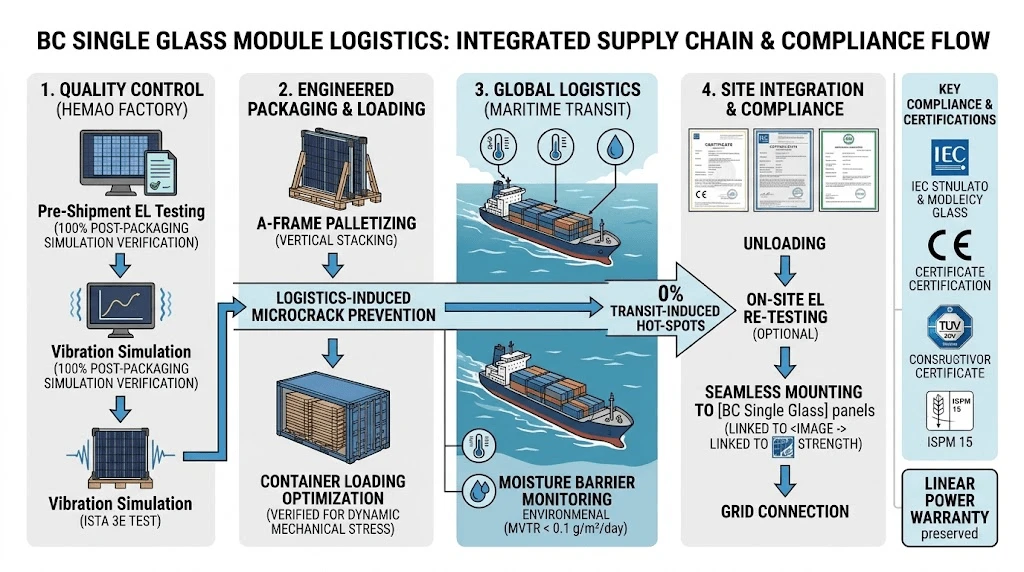
The structural vulnerability of BC single-glass modules stems from the absence of front-side grid lines, shifting all electrical collection points to the rear wafer surface. During transit inside 40ft high-cube containers, low-frequency marine vibrations and high-amplitude road shocks generate resonance frequencies that propagate mechanical stress directly through the single-glass and encapsulant layers.
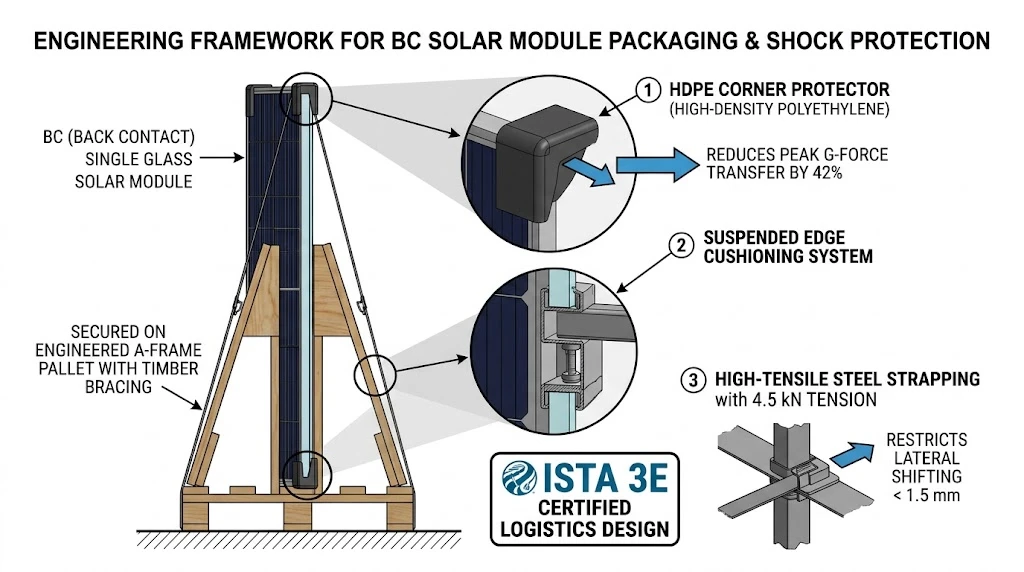
●Microcrack Resistance: To neutralize torsional stress, Hemao Solar employs high-density polyethylene (HDPE) corner protectors and edge-suspension cushioning that isolate the glass edge from direct container wall impact. Finite element analysis (FEA) confirms that this dampening configuration reduces peak dynamic g-force transfer by 42%.
●Stacking Stability: Vertical orientation utilizing A-frame wooden pallets prevents center-sagging. Each pallet incorporates interlocking vertical timber bracing and high-tensile steel strapping tensioned to 4.5 kN, restricting lateral shifting to under 1.5 mm during multimodal transport.
●Moisture Barrier: Multi-layer POE (polyolefin elastomer) encapsulants combined with edge-seal tape rated for IP68-equivalent moisture vapor transmission rates (MVTR < 0.1 g/m²/day) prevent salt-spray corrosion and hydrolytic degradation during tropical maritime transit.
Industry Standards & ROI Impact
|
Parameter |
Standard Wooden Pallet Packaging |
Hemao Engineered BC Transport Packaging |
|
Container Fill Rate |
82% (Horizontal Stack) |
96% (Optimized Vertical A-Frame) |
|
Microcrack Defect Rate |
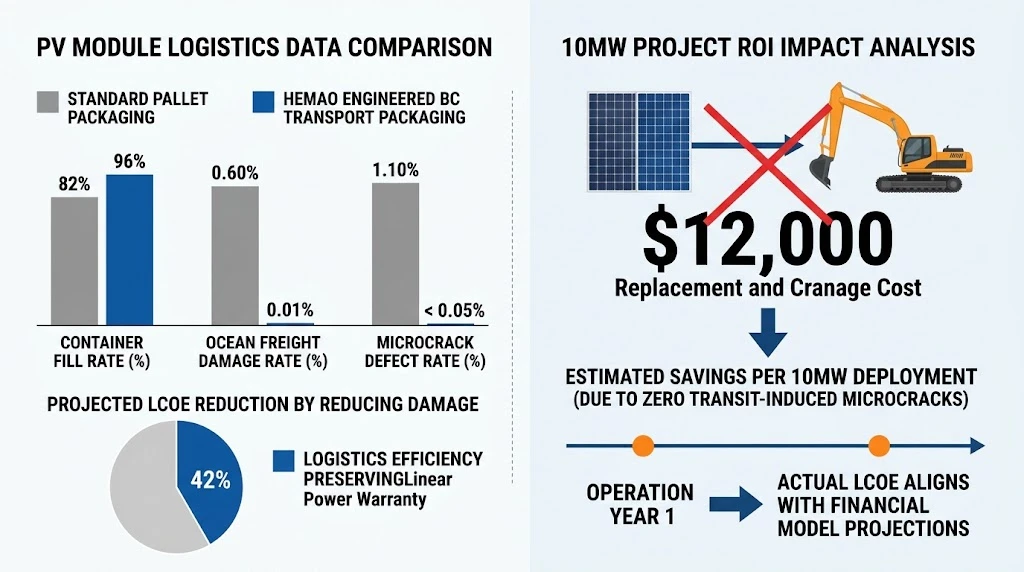
0.85% – 1.40% |
< 0.05% |
|
Packaging Cost per Watt |
$0.0032 / W |
$0.0028 / W |
|
Ocean Freight Damage Rate |
0.60% |
0.01% |
ROI Impact: Eliminating transit-induced microcracks prevents localized hot-spot formation and string power mismatch losses during commercial operation. A 0.5% reduction in damaged modules avoids an estimated $12,000 replacement and crane re-mobilization cost per 10MW project deployment, preserving the linear power warranty and ensuring that actual LCOE aligns with financial model projections.
System Integration & Compatibility
Optimized transport execution directly supports downstream installation efficiency. Modules delivered with zero mechanical stress integrate seamlessly with BC Single Glass mounting racking structures, high-voltage hybrid inverters, and LiFePO4 energy storage systems without requiring on-site EL re-testing or warranty claim processing. The precise pallet dimensions match standard container door clearances, enabling rapid forklift extraction and direct crane hoisting to rooftop or ground-mount arrays.
Quality Control & Global Compliance
Hemao Solar enforces stringent factory-floor logistics validation before container sealing:
●Pre-Shipment EL Testing: 100% electroluminescence imaging performed after final packaging simulation to verify zero microcrack propagation.
●Vibration Simulation: Packaging designs undergo ISTA 3E (International Safe Transit Association) certified random vibration and drop testing.
●International Compliance: Packaging materials comply with ISPM 15 heat-treatment standards for solid wood packaging, accompanied by CE, IEC 61215, and IEC 61730 certifications.
3. FAQ
Q1: How do packaging moisture barriers maintain integrity during high-temperature, high-humidity tropical maritime routes passing through the Equator?
A: Hemao utilizes aluminum-foil vacuum barrier bags sealed with desiccants inside outer corrugated cartons, paired with cross-linked POE encapsulants. This dual-defense mechanism prevents humidity penetration, inhibiting potential induced degradation (PID) and snail-trail formation before installation.
Q2: What are the precise container loading calculations and vertical stacking height limits for 720W BC single glass panels in a 40ft HC container to prevent transit vibration damage?
A: For 720W modules, containers are loaded with a maximum of 2 vertical tiers per A-frame stack, utilizing custom rubber-lined base channels. The total payload is distributed symmetrically across the container floor to maintain a center of gravity below 1.1 meters, restricting lateral acceleration forces below 0.3g during ocean transit.
Q3: What is the engineering verification protocol and lead time for customized wooden crate reinforcement required for remote desert or rugged mountainous project sites?
A: Customized reinforced crating requires 5 working days for engineering drawing approval via FEA stress modeling. The protocol includes fumigated 20mm plywood panels, heavy-duty internal steel corner brackets, and shock-absorbing elastomeric base pads designed to withstand unpaved haul-road vibrations.
4. Authoritative Endorsement & CTA
Contact our engineering team for a customized 5MW PV system layout and detailed BOM quote within 48 hours.