
How Solar Water Pumps Revolutionize Modern Agriculture
Technical Guide to Selecting Commercial Solar Water Pumping Systems for Large-Scale Agricultural Irrigation
Technical guide for agricultural EPCs and distributors on optimizing solar water pumping systems. Analyze MPPT logic, ROI impact, and off-grid reliability.
The Core Challenges in Agricultural PV Irrigation
Commercial agricultural irrigation projects face severe operational bottlenecks when relying on traditional energy grids or diesel generators. Diesel-powered pumps incur volatile fuel supply chains and high maintenance overheads, directly inflating the Levelized Cost of Water (LCOW). Conversely, expanding the utility grid to remote farmlands involves prohibitive capital expenditures.
While deploying a solar watering system resolves fuel dependency, standard photovoltaic installations often introduce issues regarding system reliability. Engineering, Procurement, and Construction (EPC) contractors regularly encounter system shutdowns during transient cloud cover, premature motor failure due to voltage instability, and catastrophic structural degradation in high-humidity agricultural environments.
This technical guide addresses these challenges by analyzing the mechanical and electrical architectures required to maintain stable flow rates, maximize investment recovery cycles, and ensure long-term grid independence.

Inverter Topology and Low-Light Adaptability
The core performance of a solar-powered irrigation array depends entirely on the dynamic tracking capabilities of the solar pump inverter. Standard industrial frequency inverters cannot handle the volatile DC output characteristic of PV modules. Dedicated solar pump inverters utilize advanced Maximum Power Point Tracking (MPPT) algorithms designed to match the variable torque requirements of centrifugal and submersible pumps.
Low-Light Adaptability via Dynamic VFD Logic
During early morning, late afternoon, or periods of heavy cloud cover, solar irradiance drops significantly. Standard inverters frequently stall under these conditions because the array voltage falls below the nominal operating threshold.
Advanced solar pump inverters solve this by integrating Variable Frequency Drive (VFD) software coupled with low-light MPPT adjustments. Instead of shutting down the system, the inverter continuously scales down the output frequency (30 Hz- 50 Hz) and adjusts the output voltage proportionally. This maintains the essential Voltage-to-Frequency (V/Hz) ratio needed by the pump motor, allowing water delivery to continue at a reduced flow rate rather than halting completely.
Extended Service Life and Motor Protection
Rapid fluctuations in PV output generate severe electrical stress on pump motor windings. Advanced solar pump inverters integrate several hardware protection mechanisms to extend the system's operational lifespan:
Soft-Start and Soft-Stop Functions: Eliminate the high inrush currents (which can reach up to 600% of nominal current in direct-on-line starting), preventing thermal stress in the motor and mitigating water hammer damage in the pipeline network.
Dry-Run Protection: Uses software algorithms that monitor the power factor and current draw. If the water source drops below the pump intake and torque drops instantly, the inverter shuts down the motor within seconds to prevent bearing burnout.
Phase Loss and Overvoltage Protection: Constantly scans the output lines to ensure balanced electrical delivery to the submersible pump.
Industry Standards & ROI Impact
To evaluate the financial viability of replacing diesel assets with a dedicated solar watering system, engineers must look at the total lifecycle cost. While the initial capital expenditure of a solar installation is higher, the complete elimination of fuel costs and the minimal maintenance requirements drastically reduce long-term operational expenses (OPEX).

Technical Parameter Comparison
|
Operational Parameter |
Diesel Generator Pumping System |
Premium Solar Water Pumping System |
|
Primary Energy Source |
Diesel Fuel (Variable Market Pricing) |
Photovoltaic Irradiance (Zero Cost) |
|
System Efficiency Under Partial Load |
Poor (20% -30% thermal efficiency) |
High (>99%MPPT tracking efficiency) |
|
Operational Lifespan |
12,000-15,000hours (Requires overhaul) |
25years(PV modules); 5- 8 years (Inverter) |
|
Daily Maintenance Requirements |
High (Oil filters, mechanical wear checks) |
Minimal (Periodic cleaning of PV glass surface) |
|
Environmental Protection Rating |
IP20 (Requires dedicated engine housing) |
IP65 / IP66 (Direct outdoor installation) |
System Integration & Compatibility
A robust agricultural PV installation requires seamless interoperability across the entire hardware stack, balancing the structural, electrical, and fluid dynamics properties of the project.
Structural Balancing with Mounting Systems
Agricultural solar installations must withstand specific environmental stresses, including high winds in open fields and corrosive soil conditions from fertilizers. Mounting structures must feature hot-dip galvanized steel or anodized aluminum configurations with a minimum coating thickness of 80 μm to resist chemical corrosion. Ground clearance settings must also be optimized to protect the lowest panel rows from localized crop spraying and flooding risks.
Storage and Off-Grid Compatibility
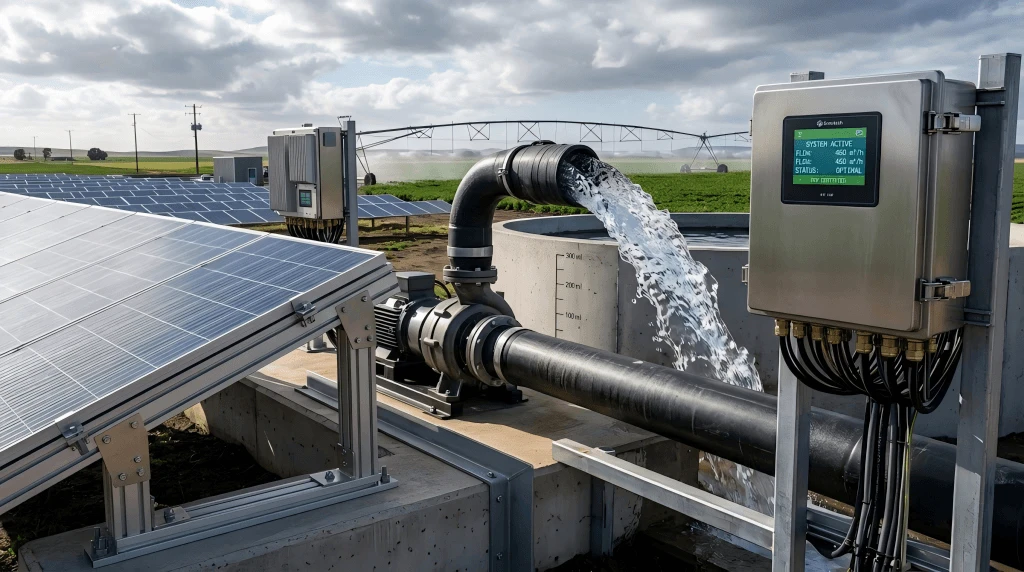
Battery storage is typically cost-prohibitive for large-scale agricultural water volumes. Therefore, system designs prioritize hydraulic storage over electrical storage. By sizing the solar array to pump excess water into elevated storage tanks or reservoirs during peak sunlight hours, the system converts solar energy directly into potential energy. This design choice removes the need for expensive Lithium-ion or Lead-Acid battery banks, streamlining system maintenance and reducing failure points.
For hybrid grid-tied operations, the solar pump inverter features dual-input terminals. When PV power drops below operational levels at night, the system utilizes internal switching relays to draw supplementary power from the AC utility grid or a backup generator without interrupting irrigation schedules.
Quality Control & Global Compliance
To satisfy the procurement criteria of government tenders and institutional agricultural developers, all system components undergo rigorous quality assurance testing before deployment.
Electroluminescence (EL) Testing: All PV modules undergo double-stage EL testing (pre- and post-lamination) to ensure the total absence of micro-cracks, latent defects, or cell mismatching that could cause hot-spots during field operation.
Inverter Environmental Chambers: Every solar pump inverter undergoes full-load burn-in testing at 50℃ ambient temperatures inside simulated high-humidity testing chambers to guarantee stable switching frequencies under maximum thermal stress.
Global Regulatory Certifications: Components fully comply with international standards including IEC 61215 and IEC 61730 for PV module reliability, alongside CE, TÜV Rheinland, and UL 1741 compliance for inverter safety and grid interaction profiles.
FAQ
1. How does the system prevent motor damage when the PV array experiences sudden voltage drops from cloud movement?
The solar pump inverter relies on internal VFD control loops rather than standard static switches. When an incoming cloud reduces irradiance, the input DC voltage drops. The inverter immediately detects this change and scales down its output frequency and voltage in real time. This keeps the current stable and prevents the motor from stalling or overheating due to voltage dips.
2. Can the solar pump inverter handle highly corrosive environments near coastal agricultural projects?
Yes. Commercial-grade inverters designed for agriculture feature an IP65 or IP66 ingress protection rating. The internal printed circuit board assemblies (PCBAs) are protected by a thick conformal coating that seals out salt mist, high humidity, and airborne agricultural chemicals, preventing trace corrosion and premature board failure.
3. What are the strict technical limitations for the distance between the solar array inverter and a deep-well submersible pump?
When the cable run between the inverter and the submersible pump exceeds $100\text{ meters}$, the high-frequency switching output (PWM) can trigger capacitive cable leakage currents and voltage spikes (dV/dt) at the motor terminals. For long cable runs, installing an AC output reactor or a sine-wave filter directly after the inverter is required to smooth out the waveform and protect the pump's motor insulation.
Engineering Support & Technical Procurement
Xiamen Hemao Industry delivers fully integrated, utility-grade solar components engineered for the world's most demanding agricultural environments. We provide complete hardware compatibility across modules, custom racking solutions, and dedicated pumping control units.
Contact our engineering team for a customized layout and detailed BOM quote within 48 hours.